Hold on to Peace - Image courtesy Ira Mitchell-Kirk

Hold on to Peace - Image courtesy Ira Mitchell-Kirk

Friday, 31 December 2010

And So It Continues...

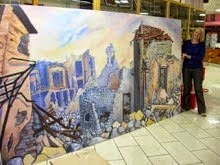
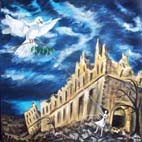
"Cassino Requiem" 2010 (diptych) - Gilmore Wall

Today the newspapers report that another Italian soldier has been killed in Afghanistan. New Zealand too has lost another national in Afghanistan, killed earlier this month. And so it continues.

It is New Year's Eve, and time to catch up on some blog posts long overdue. I would like to be writing about the art works, the artists, the exhibition. I prefer to write about peace, not war. But, while war continues, it seems that we must work both for peace, and an absence of war. Newspapers question why we are fighting in these places. Others suggest that career soldiers are simply working in a dangerous job, and no more heroes than anyone else killed on a work site.

We say "Don't be a hero" when we are really saying "Come home safely". Is it no more, no less than this? There are people who perform extraordinary acts under pressure, but there is surely no heroism in fighting a war with military presence. Peace comes from building bridges, not bombing them.

While reviewing Legato artist statements for this blog I was struck by the lines at the end of this email from Gilmore Wall of Auckland. Gill's challenging imagery (photo above) bridges the 65+ years from WWII until today.

The Second World War had a major impact on my family with many uncles, cousins and my father serving in all three armed forces in Europe, North Africa and the Pacific. The family lost one cousin in the Battle of Britain as a tail gunner in a bomber, another taken prisoner in the Pacific and my father was wounded in the battle of El Alamein, Egypt which ended his war.

Our uncle Lawrence Gilmore fought all three theatres with 2NZEF from North Africa including Cassino and made it through unscathed only to be sent to the Pacific where his brother (Robert) was. He is one of the last members of his generation of our family still living well into his eighties. He was away from home for five years. Like many of his contemporaries they speak little of their experiences during their time at war and so it remains difficult for following generations to fully understand what it was like. We can only speculate as to how horrific it must have been.

My father told the story of the day the war ended finally in the Pacific and he was on our grandparent’s farm, having just met our mother Isobel Jean (Lawrence’s sister), whence our grandfather collapsed and died in his arms from what must have been pure stress from waiting for his sons to return home. They never got to see their dad again.

My submitted artwork therefore depicts both my wife and my families’ connection with World War II and in particular Cassino. The imagery has been derived both from collections held at the Auckland War Memorial Museum and from personal mementoes telling the story of the coming together of many cultures as one nation protecting our freedom as a way of life. Unfortunately this is a repeated theme in our lifetimes.

We must ask ourselves, as we start the new year, how many more lifetimes will we let it continue? Wouldn't it be great if we had to turn to museums and historians for information about wars, instead of simply picking up a newspaper and turning on the television to watch our bloody history being made?

Mother Theresa said "Peace begins with a smile". Happy New Year, artists and peace workers. We can all be peace workers, join any of the many movements around the world. Bring whatever skills you have, but all you really need to bring is a smile.

Friday, 24 December 2010

Christmas with the troops all over the world.

While we think of the troops overseas away from families, fighting because they believe they must, so too are many peace workers away from home and in dangerous situations. Peace is more than a prayer at Christmas time, a fleeting thought amongst the festivities. John Lennon's "So This is Christmas" is sobering and challenging.

Working for Peace:
This group of young German, Italian and Polish students listen to the veterans, visit the battlefields and cemeteries and share prayers for peace (Cassino, October 2010).


The need to work for peace is greater than ever before.

*****

As we eat our Christmas chocolate, do we spare a thought for where it came from? It might be a shock to learn that the home of 40% of the world supply of cocoa is currently on the brink of war, or, depending on your definition, is at war. Your Christmas treats, hard earned, may cost you much more soon. It will hit your pocket, but will it also hit your heart?

Wars continue, often unnoticed as we pursue our busy lives. When it hits us in our wallets, or in our supplies of things we consider to be our normal right, does it bring it home to us a little more?

This link to the BIPPI website gives a glimpse of how much work needs to be done to have any chance of peace and harmony, for people to be able to live in peace. Peace is not merely an absence of war, but as fervent peace worker Bruno Picozzi puts it, "Peace is what happens when all peoples are free to develop themselves in the way they want, without having to fight for their rights." (Bruno Picozzi)

Yesterday I was reading of a war I hadn't even noticed evolving. Other nationals are being urged to leave the Ivory Coast as civil unrest verges on civil war. Power, it seems, was linked to cocoa production.

Today I made the usual Christmas treats, New Zealand recipes to take to Italian homes. Cocoa featured in many of them. The cocoa powder spilt on my bench "runner" refused to brush off easily, remaining for now a stain the colour of dried blood. It's not that I am bent on focusing on the brutality of war, in fact I much prefer to focus on peace. But living as I do between the Gustav Line and the Hitler Line, visited by historians and tourists wanting to know more about the history, it is difficult to extract myself from the sorrow of the history at times.

*****

My father tells of spending a wartime Christmas in Italy with his two brothers, where they celebrated by sharing a bottle of brandy. How lucky they were to be able to reach one another from their respective locations. My favourite story is his Christmas pudding story. This arrived too late for Christmas, so was being saved for a special occasion. That occasion arrived on the following Good Friday, when he survived being buried alive in an aerial attack on the Allied troops behind Mt Trocchio at Cassino.

So, this Christmas, let's not just look at the Christmas stories of WWII, but, as Katherine Jenkins does so beautifully, spare a thought for all those engaged in combat wherever they are, for what ever motive, this Christmas. This Youtube tribute to Katherine's work gives a glimpse of what continues today, from a more peaceful perspective. Art, music, writing... it all makes a difference. Whether or not troops should be where they are is for each of us to evaluate according to our own beliefs, but the fact remains that war continues and we must use every talent we possess to ease the suffering that continues today.

As I watch former foes greet one another as friends, German veterans and Polish veterans embracing as they remember their battles, I think of the magical song "Silent Night". In 1965 I learnt the original German version of Silent Night. Then only 20 years after the war, it was still too soon for Kiwi soldiers to be hearing it and was controversial for it to be taught in schools. Now we look at a peaceful Europe and wonder how could once have been so torn by war.

There is hope. But it seems that building peace takes more effort than going to war.

Monday, 13 December 2010

Music and Images for Peace


As some of the artists know, getting art work out of Italy is a difficult and expensive process. Artworks are seen as cultural heritage, and the protocol to take any art out of the country is severe to say the least. Some very generous artists have chosen to donate their work to local venues, like senior citizens homes. The work of one artist in particular, Angela Laby, I am hoping to place in schools as this work has text in English that would interest the children. (See photograph above). A picture is worth a thousand words, but when one grows up with words of peace in a picture seen every day, one must surely remember these for a lifetime.

The decision to work also with schools was affirmed for me this afternoon. I was invited to a school in Cassino to watch the end of year concert (a middle school, children around 12 - 13 years old I guess). This was in a fairly typical school hall, with excited children and throngs of parents. But the programme was far from typical. It was not about success and achievement, not about the school year. The theme of all the dialogue and songs was of sharing resources and cultures, of working to end poverty and oppression, and for peace. The theme appeared to be that Christmas is a time for thinking of others, and for understanding the true message of Christmas. This programme was not a "one off", but is repeated six times over two weeks to ensure that everyone has a chance to see it.

Each part of the world was presented with songs and dialogue, and finished with lighting a candle of hope for the children at risk in these places. Europe was represented in both French and Italian. The Americas were presented with both negative and positive stories, and the song (in English) "What a Wonderful World". When it came to Oceania I watched with much interest. What would it be? Children with painted faces, brown skivvies and tights, and "grass" skirts appeared... and to my amazement they performed a very convincing haka. This brought the audience to life far more than any other performance, and an encore was called for, not once, but twice. Later, despite two intervening acts of song and movement, as the hall emptied I could hear "Kamate, kamate..."

I waited behind to speak with the instructor, and to my surprise he knew much about the haka, the history, the protocol. This was no "dance rip-off" like the controversial car advertisement, but a true cultural exchange. Such is the memory in the town of Cassino of the performance of the NZ Army culture group in 2004.

This, together with a lovely book and photographs in today's post from Canadian visitors to Legato who said in their letter "Keep up the good work", has given me much heart.

Legato is a lot of work, finding funding is difficult, and at times it is a very lonely journey. Occasionally I wonder why I spend so much of my time and energy on this project. Then, when I see the generosity of artists, see how the art works move visitors, and remember the stories told to me by visiting veterans, I am very sure that, despite all the difficulties and frustrations, "the show must go on".

Thankyou Angela, for responding positively to the proposal to donate works to the people of Cassino. Today I think I found the right place for your messages of peace.

Saturday, 13 November 2010

They Died, for What?

Tomorrow at Caira is a ceremony for the 20,000 German soldiers who lie, six to a headstone, on their bleak conical hilltop near Cassino. Two days ago it was Remembrance Day, with ceremonies in far-flung places, and more to come tomorrow, Sunday. It is a time to remember all soldiers, and civilians too, and consider that there are no winners in war. The surviving soldiers were victims too, and societies continue to suffer from events that happened more than 65 years ago.

I was browsing "Remembrance Day" and Google produced a Canadian story (click here) typical of scenes all over italy.

Once Armistice Day, and renamed after WWII as Remembrance day, the moment of the 11th hour of the 11th day of the 11th month each year is often commemorated on the Sunday closest to the 11th of November. This link has a comprehensive coverage of the history of the day, written for children. Please note the section added in grey, the text being:
We will remember all .....

Sadly, due to the current intensive operations, the names of many young men and women are now being added to war memorials throughout the land.

We give thought also to the many who are injured but, due to the miracles of modern medicine, are increasingly surviving with horrific injuries.

So, on Remembrance Day, we remember these people as well as those from the two great wars.


***


The challenging sculture by Dave Fowell asks what the civilians of Cassino would think, if they returned to look at the world now. Have we achieved the peace that "we" were fighting for when they lost their lives? Artists exhibiting in Legato had differing opinions.

Dave Fowell at Legato, Italy 2010 from Nicola Blackmore on Vimeo.

Dave Fowell suggests that nothing has changed, but argues that war is not the way to make changes for the better, while Averill Stuart-Head believes that soldiers able to return 65 years later would be satisfied that gains had been made and that the younger generations have better lives because of their sacrifices.

Quilted wall hangings by Averill, "Postcards to Peace" and "Doorways to Peace".


Averill Stuart-Head at Legato, Italy 2010 from Nicola Blackmore on Vimeo.

Averill speaks about her work and the soldiers who lost their lives.

Averill says that "Peace is so fragile, and we have to look after it". How easy it is to forget that, and how tragic the consequences when we do.

Works below: Collages by Averill, "Fragments of Peace"

Friday, 5 November 2010

Behind the Scenes


Legato (Italy 2010) is now all in boxes, packed ready to return to New Zealand. Some work is already safely back in New Zealand, so my sincere thanks go to the artists who took work back with them, some also taking work for others. Some is in the post, some has been posted and bounced back to me from customs, and other works are waiting until the intricacies of exporting artworks can be negotiated - that is, until I can get it all signed off in Rome.

Some generous artists have decided to donate their works to public spaces in Italy, and as soon as the madness of olive picking is over I will place these works. It's not only my own olives causing hold-ups, but the whole region slows down as people return to the countryside to make wine or pick olives. Frustrating perhaps for outsiders, but it is part of the charm that is Italy. You can cross hundreds of years in a day, if you happen to pass a woman carrying her supplies on her head, or an old man leading a mule laden with firewood up cobblestone paths, then look in on an oil press where the latest of technology is gleaming next to cane baskets of olives. I need to talk to the vice-mayor about placing some of the works, but he happens to own the local olive press... pian-piano, as they say here, or (in NZ) "good things take time".

Next week I should be back at my own computer, and luckily my data was salvaged and survived the reformatting of the hard drive. Then I will be able to access more readily the photographs and data I need for this blog.

In the meantime, above are more photos of Janice Corbishley's work which went "on location" to the restaurant at La Locanda del Castello for an evening a few weeks ago, before it was safely delivered home to New Zealand by a travelling artist.

Monday, 4 October 2010

Legato in New Zealand

The new Wallace Gallery, Morrinsville, will host Legato in 2011. The opening event will be Friday 18th February, and the exhibition will run until 16 March.

Before then, though, there are still works to be written about for this blog, and a new brochure to be compiled.

Each time I am ready to take the works down from the wires I get word that someone else is coming to see the exhibition. This weekend it was an Italian family of five, who were particularly moved by the watercolours by Sarah Scott. These powerful works were also appreciated by members of the New Zealand group who visited during the week. The paintings by Susan Edge also drew questions and comment as the Italian viewers appreciated the quality of the paintings and sought to understand the meanings behind the compositions.

The Kiwi visitors were so interested in the work and the history of the exhibition space and the battle of Cassino, and asked so many interesting questions, that I forgot to take photographs of the group in the exhibition.

A recurring theme coming up in discussions here, being volunteered by people who visited Legato in Cassino, is the passion and emotion in the paintings. Quite clearly the balance of works, the varied approaches, and the emotional links to the works is being read well by the Italian viewers. While a few works are standing out as being the most powerful, poignant or memorable for visitors, it is the diversity that creates a cultural richness in the exhibition.

Thursday, 23 September 2010

On their way home.


One of the most admired works in Legato is on its way back to New Zealand, travelling as precious hand luggage. This beautiful bust by Janice Corbishley is a fine example of the interweaving of memory, emotions, aesthetic appeal, and expert skills. More detail can be seen here on Facebook.

What has been interesting with this piece is that inevitably people who have been drawn to the work have also read every word of the text and the artist's biography, and I am sure will remember the link between the artist's uncle and the battles here in Italy.

If you are interested in seeing or commissioning more of her exquisite work Janice may be contacted through her website Mosaic Heirlooms or at the Red Peach Gallery.

Next Tuesday is the last day of the exhibition in Italy, and then other works begin to wend their way home.