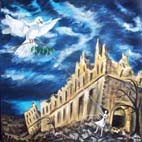

Monday, 31 March 2014


Legato goes to Ortona with the MCFRR and the Comune di Cassino.
Ortona on the Adriatic Coast is twinned with the city of Cassino. The "Gustav Line" which was established and vigorously defended by the Germans stretches from the Adriatic coast near Ortona across Italy, linking the towns in this battle in the winter of 1943/44 (until the liberation of Cassino in May 1944).
For the 70th commemorations of the Battle of Ortona, the Comune of Cassino joined with the people of Ortona to present an exhibition for commemoration, "ORTONA CASSINO una Linea di Unione". The Monte Cassino Foundation for Remembrance and Reconciliation (MCFRR) was invited to present works from Legato in a joint exhibition with local artists from the Ortona branch of U.C.A.I.
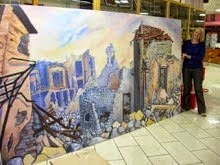
The magnificent venue in the Palazzo Farnese gave some of these works their best showing aesthetically, as larger works are a little difficult to display in local spaces with set size openings or where walls are marble or plaster.
Below are some of the photographs from the event, but because the rooms were so full of guests and people were wanting to ask questions and discuss individual works I was not able to get many good photos showing the works to advantage.
The event was opened with powerful choral singing, speeches and finally a visit to the exhibition. I was very pleased to hear the Monsignor advise people to look carefully at the visiting works and to consider the messages that were within them. He had clearly spent some time contemplating these himself.
Art (images) and music are very international languages. Sometimes they allow people to unlock things that have been buried for too long. It is wonderful to hear, five years after the first Legato, how works are continuing to have an impact on the people who contemplate the images.
I offer a very sincere thank you to the artists who continue to allow me to share their works in Italy.


For the 70th commemorations of the Battle of Ortona, the Comune of Cassino joined with the people of Ortona to present an exhibition for commemoration, "ORTONA CASSINO una Linea di Unione". The Monte Cassino Foundation for Remembrance and Reconciliation (MCFRR) was invited to present works from Legato in a joint exhibition with local artists from the Ortona branch of U.C.A.I.
The magnificent venue in the Palazzo Farnese gave some of these works their best showing aesthetically, as larger works are a little difficult to display in local spaces with set size openings or where walls are marble or plaster.
Below are some of the photographs from the event, but because the rooms were so full of guests and people were wanting to ask questions and discuss individual works I was not able to get many good photos showing the works to advantage.
The event was opened with powerful choral singing, speeches and finally a visit to the exhibition. I was very pleased to hear the Monsignor advise people to look carefully at the visiting works and to consider the messages that were within them. He had clearly spent some time contemplating these himself.
Art (images) and music are very international languages. Sometimes they allow people to unlock things that have been buried for too long. It is wonderful to hear, five years after the first Legato, how works are continuing to have an impact on the people who contemplate the images.
I offer a very sincere thank you to the artists who continue to allow me to share their works in Italy.
The cathedral choir opened the event.
Dr Danilo Salvucci, (Consigliere Comunale and president of the committee for the 70th anniversary of the Battle of Cassino) represented the Comune di Cassino.
Kay de Lautour Scott represented the MCFRR and Legato Exhibitions.

Friday, 3 January 2014
Five years of Legato Exhibitions
As we approach the fifth year of Legato it seems appropriate to review the origins again. What is Legato, and why do I dedicate so much of my time and energy to it?
The answer is simple. In 2005 I was offered the chance to exhibit in Cassino. This exhibition brought me closer to the realities of war. As an artist and a person it was life changing. I became much more aware of the legacy of war, and of how much we are still a long way from living in peace. I wanted to offer other artists what I had been given in 2005 at the Battle of Cassino War Museum.
Legato has given artists a specific reason to talk with veterans, and I now see that it has served both the veterans and the artists equally well. The veterans have a chance to revisit their memories in a warm, responsive context, sharing as much as they need to, without pressure to record for history what they may choose to forget.
The late Douglas Lyne (MCFRR) encouraged me to think big. I had hoped to offer artist residencies but instead Legato was born.
This is how I saw it in 2010: I think it still applies now.
Who, What, Why, When, Where?
The answer is simple. In 2005 I was offered the chance to exhibit in Cassino. This exhibition brought me closer to the realities of war. As an artist and a person it was life changing. I became much more aware of the legacy of war, and of how much we are still a long way from living in peace. I wanted to offer other artists what I had been given in 2005 at the Battle of Cassino War Museum.
Legato has given artists a specific reason to talk with veterans, and I now see that it has served both the veterans and the artists equally well. The veterans have a chance to revisit their memories in a warm, responsive context, sharing as much as they need to, without pressure to record for history what they may choose to forget.
The late Douglas Lyne (MCFRR) encouraged me to think big. I had hoped to offer artist residencies but instead Legato was born.
This is how I saw it in 2010: I think it still applies now.
Who, What, Why, When, Where?
New Zealand artists will be exhibiting in an exhibition for peace and remembrance in Cassino, Italy, 15 - 29 May 2010. The venue is the Pietromalatesta rooms, Bibilioteca Comunale, in central Cassino, and the exhibition will be hosted by the Cassino Comune.
Here, in tourist destination Italy, I live in a country that was destroyed. The battle front stayed in this area for 5 months. It is unthinkable how the people suffered, and still do live with this history in their daily lives. I see museums showing the military side of things, the strategies, the equipment, but it is the photos and stories of emotional pain and suffering that touches me most.
I work as a volunteer with visiting veterans groups, with memorial museums and as a battlefield tour guide. Many veterans share their stories, and all say sorrowfully that we must never let such events happen again. To share time with these old soldiers, and then see what is happening still all over the world, leaves me feeling that I must try to do something, however insignificant it might seem.
I see curating an exhibition with peace and commemoration as a theme as a way of passing on the message from the veterans that I meet, that war must end. I also see it as a great opportunity for NZ artists to exhibit in Italy. I appreciate that side of it as I had a similar chance in 2005, but more important to me is keeping the peace message alive.
We see Anzac Day parades growing in strength. I believe the time is right for artists to reinforce the peace messages coming from the soldiers who fought in this battle. I think that artists have a responsibility to reflect what is happening in society, and in fact they do that whether they are conscious of it or not. The immeasurable, unrecorded history is that of the returned soldiers, the waiting families, the changed lives in far away New Zealand.
How far did the events in Europe ripple through our culture, contributing to the society we have now? What effect did the trauma of battle have on the young men returning home to families who could not begin to understand what they had been through? What was the effect of the waiting, the pain of loss, on the families that remained behind? If giving artists this opportunity gets them talking to their family and friends then I think that the movement towards peace has already become stronger, and this movement will be recorded in their future works.
If we all do a tiny part in a move towards international peace we must eventually reach a tipping point where we can change nations and governments. One British veteran talks about "pax in spinus" (peace from thorns) and I see that as being appropriate here. If we let this continue, never learning, then there is no sense in sending soldiers out believing that they are contributing to peace. While I believe that no war ever brought real peace, we can't ignore what has happened either. Peace comes from a different place, but war history and commemoration is a place where we can start to talk about peace.
Cassino was completely destroyed and is recognised as a martyr city. It has a lasting place in New Zealand history, so where better place is there to call NZ artists together to work for peace? It is my hope that these artists will continue to learn more about what happened here, and in other places, and continue to produce works that further the work of peace movements throughout the world.
Here, in tourist destination Italy, I live in a country that was destroyed. The battle front stayed in this area for 5 months. It is unthinkable how the people suffered, and still do live with this history in their daily lives. I see museums showing the military side of things, the strategies, the equipment, but it is the photos and stories of emotional pain and suffering that touches me most.
I work as a volunteer with visiting veterans groups, with memorial museums and as a battlefield tour guide. Many veterans share their stories, and all say sorrowfully that we must never let such events happen again. To share time with these old soldiers, and then see what is happening still all over the world, leaves me feeling that I must try to do something, however insignificant it might seem.
I see curating an exhibition with peace and commemoration as a theme as a way of passing on the message from the veterans that I meet, that war must end. I also see it as a great opportunity for NZ artists to exhibit in Italy. I appreciate that side of it as I had a similar chance in 2005, but more important to me is keeping the peace message alive.
We see Anzac Day parades growing in strength. I believe the time is right for artists to reinforce the peace messages coming from the soldiers who fought in this battle. I think that artists have a responsibility to reflect what is happening in society, and in fact they do that whether they are conscious of it or not. The immeasurable, unrecorded history is that of the returned soldiers, the waiting families, the changed lives in far away New Zealand.
How far did the events in Europe ripple through our culture, contributing to the society we have now? What effect did the trauma of battle have on the young men returning home to families who could not begin to understand what they had been through? What was the effect of the waiting, the pain of loss, on the families that remained behind? If giving artists this opportunity gets them talking to their family and friends then I think that the movement towards peace has already become stronger, and this movement will be recorded in their future works.
If we all do a tiny part in a move towards international peace we must eventually reach a tipping point where we can change nations and governments. One British veteran talks about "pax in spinus" (peace from thorns) and I see that as being appropriate here. If we let this continue, never learning, then there is no sense in sending soldiers out believing that they are contributing to peace. While I believe that no war ever brought real peace, we can't ignore what has happened either. Peace comes from a different place, but war history and commemoration is a place where we can start to talk about peace.
Cassino was completely destroyed and is recognised as a martyr city. It has a lasting place in New Zealand history, so where better place is there to call NZ artists together to work for peace? It is my hope that these artists will continue to learn more about what happened here, and in other places, and continue to produce works that further the work of peace movements throughout the world.
Wednesday, 30 October 2013
Legato 2014 and the 70th Commemorations of the Battles for Cassino
"Freedom" 2010 photograph by Lorraine Beattie

Legato 2014 and the 70th Commemorations of the Battles for Cassino
Useful Links for Artists
An email from one of the artists working towards the May 2014 exhibition prompted me to publish research links for others to read as well. These are all published below in good faith with no copyright breach intended.
The story, and plight of the women in the region is told in the oscar-winning Sophia Loren film La Ciociara (English title Two Women), highly recommended viewing. Available (in segments) on Youtube, may also be full version available. Click on this link. for Part 1 of the movie.

The famous John Huston documentary The Battle of San Pietro (Infine) was named as one of the most important 100 films made in America last century.
Detailed research in a major publication with many photographs and a well referenced text. The Battles for Monte Cassino Then and Now By New Zealand authors Jeffrey Plowman and Perry Rowe.

New Zealand Official War Histories online at NZETC (Electronic Texts collection)
The Years Back - The Italian Campaign: a 1973 NZonscreen documentary. Footage of conditions gives a clear picture of fighting in mud and snow. And in Cassino itself then onwards up through Italy, the documentary continues.
Ron Crosby's excellent book ALBANETA Lost Opportunity at Cassino which tells the lesser known story of Cavendish Road.

Documentary or newsreel film: Unveiling of the memorials at the Commonwealth Cemetery, 1956, some other footage, in Cassino Remembrance, by AP Archive.
New Zealand War Graves Project
 Photo: The War Graves Project, http://nzwargraves.org.nz/cemeteries/cassino-memorial

The best research, however, will always be talking to those who were here, and those who were waiting at home. Artists who have made work for earlier Legato exhibitions have described their involvement, and their research, as "life-changing". Legato becomes a catalyst for conversations that have been waiting to happen.
Artists are reminded that the themes are peace and commemoration, and that works of any genre may be submitted for consideration. If you are interested in joining the 2014 artists exhibiting in Cassino please contact the organiser and curator, Kay de Lautour, at:
legato.exhibitions @ g mail . com (without the spaces)
To read more of the history of Legato and find other useful links please scroll down two posts (22 August) or click here to go directly to that link.
Recommended background information and excellent images of the conditions the battles were fought in, the first twenty minutes of Jim Greenhough's excellent 2003 documentary produced for the 50th Commemorations is now available on YoutTube :
A Kiwi Nightmare - the Battles of Monte Cassino. A documentary by Execam The story, and plight of the women in the region is told in the oscar-winning Sophia Loren film La Ciociara (English title Two Women), highly recommended viewing. Available (in segments) on Youtube, may also be full version available. Click on this link. for Part 1 of the movie.

The famous John Huston documentary The Battle of San Pietro (Infine) was named as one of the most important 100 films made in America last century.


The Years Back - The Italian Campaign: a 1973 NZonscreen documentary. Footage of conditions gives a clear picture of fighting in mud and snow. And in Cassino itself then onwards up through Italy, the documentary continues.
Ron Crosby's excellent book ALBANETA Lost Opportunity at Cassino which tells the lesser known story of Cavendish Road.
Documentary or newsreel film: Unveiling of the memorials at the Commonwealth Cemetery, 1956, some other footage, in Cassino Remembrance, by AP Archive.
New Zealand War Graves Project


Web links: Associazione Battaglia di Cassino Centro Studi e Ricerche FB page, excellent photographs filed under different folder headings. Dal Volturno a Cassino research site with some articles in English.
The best research, however, will always be talking to those who were here, and those who were waiting at home. Artists who have made work for earlier Legato exhibitions have described their involvement, and their research, as "life-changing". Legato becomes a catalyst for conversations that have been waiting to happen.
Artists are reminded that the themes are peace and commemoration, and that works of any genre may be submitted for consideration. If you are interested in joining the 2014 artists exhibiting in Cassino please contact the organiser and curator, Kay de Lautour, at:
legato.exhibitions @ g mail . com (without the spaces)
To read more of the history of Legato and find other useful links please scroll down two posts (22 August) or click here to go directly to that link.
Tuesday, 15 October 2013
UXOs in Italy

"They Were Only Boys: 1944-2010" by Kay de Lautour (Watercolour, 2010).
UXOs in Italy
“… my generation, we grew up knowing that the
war was finished just 10 - 15 years before, and we had to deal with danger -
like there were still mines around - there were the things that could be
dangerous for children so at school we were talking about these things, talking
about the war.” (Margherita Giampietri, Cassino
Immediately
after the war Allied engineers and civilians began the mammoth task of clearing
the hundreds of thousands of mines and other unexploded devices in the
buildings, towns and countryside where the front line had passed. Much of this clearing followed roads and
other communication lines, but did not always go deep or extend into the wider
parts of the battlefields.
The scale
of the problem is hard to imagine in peace time. Thousands of German mines had been used in
buildings and the fields, and when the town of Cassino was bombed an area of
approximately 400 x 1400 square metres received an estimated 1000 tons of
bombing. Historians have calculated that
for every German defender in the town, 4 tons of explosive was used.
Many army
and civilian workers were killed or maimed during the clear-up operations, as
were civilians who collected and attempted to defuse the weapons to sell for
scrap metal when their families were starving in post-war Italy
Almost
seventy years have passed, and while every year more UXO (Unexploded
Ordinances) are collected and this dangerous legacy is reduced, many still
remain in the hillsides and buried at Cassino
There are
many factors that could be contributing to this. As time goes on, these “pieces of metal”
found in the ground are becoming more unstable.
Many are being uncovered through erosion, or are much closer to the
surface than before. More land is being
brought back into production and the ordinances are being uncovered by
horticultural machinery or during excavations for roads, swimming pools and
houses.
A
concerning factor is the lack of knowledge about the danger. New generations are unaware of what can
happen and take risks when they find ordinances in their daily life. Adventure tourism, walking tours, camping
holidays, re-enactments and battlefield tours take locals and visitors on paths
that are not guaranteed to have been included in the initial clearance of
UXOs.
Collectors
are seeking relics for themselves, or to exchange or sell via the internet,
some putting themselves at risk of physical harm. Italian law is quite clear about this; the
collection of dangerous objects is strictly illegal. For the casual explorer and hiker who is not
looking for them there is danger too.
The
following examples have been taken from the internet. It is not a complete list, and most are
sourced from online newspapers.
May
2005 An operation to remove a 250 lb
bomb that closed the centre of Formia and interrupted the railway services
between Rome and Naples
September 2008 A 500lb bomb was
found at Salerno
29 September 2009 Two youths
recognised an object in the Volturno
River
14 March 2010 an
unexploded bomb containing 118 lbs of TNT was removed from Tiburtino, Rome
21 April
2010 Rail services between Naples and Cassino were suspended while a bomb was removed between
Vairano and Cassino
24 May
2010 Army expert bomb disposal unit
safely disarmed another 70kg bomb, this bringing the number of callouts to
approximately 200 since their recent deployment to this task in southern Italy
17
September 2011 An unexploded bomb was
found in a suburban area in Cassino
29 January
2012 A grenade that had become embedded
in a tree exploded and destroyed the fireplace when the wood was used in a
domestic fireplace in a village near Cassino
7 July 2012
Traffic was diverted near the Pontecorvo exit when an unexploded 30cm heavy
artillery projectile was noticed lying in the gutter at the side of the
autostrada. It is not known how it came
to be there.
14 July
2012 A fisherman noticed a bomb in the Liri River
13 July
2012 A 500lb bomb was discovered in Salerno
And so it
continues.
What should
be done when you find what could be an unexploded ordinance, a dangerous legacy
from the battle? Don’t touch the object,
but call the authorities immediately. The danger is real, the problem has not
gone away. It is only the memories that have diminished with time.
Margherita Giampietri interviewed by Nicola
Blackmore at Legato, mostra per la pace
e commemorazione, Cassino, Italy, 2010.
Article by Kay de Lautour (MCFRR).
Article by Kay de Lautour (MCFRR).
Thursday, 22 August 2013
Legato 2014 and the 70th Commemorations of the Battles for Cassino

"Freedom" 2010 photograph by Lorraine Beattie
Preparations for Legato 2014, part of the commemorations for the seventieth anniversary of the end of the battles for Cassino, are well underway. Accommodation for travelling artists has been pencilled in. Venues are booked and extra venues are being viewed and considered as Legato grows. It is an exhausting but exciting time as letters go out to artists and emails come back in. Formal applications to contribute to the 2014 exhibition are being called for in September.
Legato was established by New Zealand curator and organiser Kay de Lautour Scott in 2010 after discussions in London and in Italy with veteran Douglas Lyne (1921-2010), founder of the Monte Cassino Foundation for Remembrance and Reconciliation, about the role of the arts in international understanding and cultural exchanges in peace work.
Exhibitions to date:
2010 Cassino, Italy (NZ artists with German & Italian NZ artists)
2010 Roccasecca (FR) Italy (NZ artists)
2011 Wallace Gallery, Morrinsville, New Zealand (NZ artists)
2011 Cassino, Italy (NZ, Canadian & Italian artists)
2012 Cassino, Italy (NZ, Canadian, Hungarian, English & Italian artists)
2012 Roccasecca (FR), Italy (NZ, Canadian & Italian artists)
2013 Monte San Giovanni in Campano, Italy (selected NZ artwork)
2013 Cassino, Italy (NZ, Canadian, Italian, Russian, USA & English artists)
While essentially a New Zealand exhibition, approximately 60 artists of seven different nationalities have contributed to Legato to date.
To help newcomers to Legato find their way around the blog and videos, here are some useful links.
The history of Legato (blog post)
Why "Legato"? (blog post)
A range of videos:
Mosaic artist Janice Corbishley discusses her work and involvement in the Legato Exhibition
Painter Jon Stevenson explains his artwork and his trip to Cassino
Mixed media artist Frances Rookes interview at Legato
Photographer Lorraine Beattie interview at Legato
Italo-Kiwi Margherita Giampietri discusses her work and the logistics and benefits of taking part in international exhibitions, and compares Italian and NZ post-war experiences video
General background and artist comments (2010): Legato at Cassino (video)
The opening in 2010: Legato opening (video, short version)
Artists hold a short service of remembrance at the Commonwealth cemetery (video)
The first Legato exhibition, Cassino Italy 2010 (blog post)
Legato on Vimeo (click here for link to 15 videos)
Thanks to Nicola Blackmore of feijoafilms (Scotland and Melbourne) for travelling to Italy to produce these videos in 2010.
Legato on Facebook: https://www.facebook.com/pages/Legato-Exhibition-Italy/109656259065551?fref=ts
Subscribe to:
Posts (Atom)



 Posts
Posts


