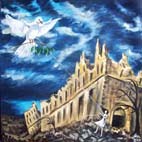
Hold on to Peace - Image courtesy Ira Mitchell-Kirk

Hold on to Peace - Image courtesy Ira Mitchell-Kirk

Wednesday, 30 October 2013

Legato 2014 and the 70th Commemorations of the Battles for Cassino


"Freedom" 2010 photograph by Lorraine Beattie


Click on the link below for background information and video clips of previous Legato exhibitions:
Legato 2014 and the 70th Commemorations of the Battles for Cassino

Useful Links for Artists

An email from one of the artists working towards the May 2014 exhibition prompted me to publish research links for others to read as well. These are all published below in good faith with no copyright breach intended.

Recommended background information and excellent images of the conditions the battles were fought in, the first twenty minutes of Jim Greenhough's excellent 2003 documentary produced for the 50th Commemorations is now available on YoutTube :
A Kiwi Nightmare - the Battles of Monte Cassino. A documentary by Execam

The story, and plight of the women in the region is told in the oscar-winning Sophia Loren film La Ciociara (English title Two Women), highly recommended viewing. Available (in segments) on Youtube, may also be full version available. Click on this link. for Part 1 of the movie.


The famous John Huston documentary The Battle of San Pietro (Infine) was named as one of the most important 100 films made in America last century.


Detailed research in a major publication with many photographs and a well referenced text. The Battles for Monte Cassino Then and Now  By New Zealand authors Jeffrey Plowman and Perry Rowe.

New Zealand Official War Histories online at NZETC  (Electronic Texts collection)

The Years Back - The Italian Campaign: a 1973 NZonscreen documentary. Footage of conditions gives a clear picture of fighting in mud and snow.  And in Cassino itself then onwards up through Italy, the documentary continues.

Ron Crosby's excellent book ALBANETA Lost Opportunity at Cassino which tells the lesser known story of Cavendish Road.


Documentary or newsreel film: Unveiling of the memorials at the Commonwealth Cemetery, 1956, some other footage, in Cassino Remembrance, by AP Archive.


New Zealand War Graves Project
Photo: The War Graves Project, http://nzwargraves.org.nz/cemeteries/cassino-memorial


Web links: Associazione Battaglia di Cassino Centro Studi e Ricerche  FB page, excellent photographs filed under different folder headings. Dal Volturno a Cassino research site with some articles in English. 

The best research, however, will always be talking to those who were here, and those who were waiting at home. Artists who have made work for earlier Legato exhibitions have described their involvement, and their research, as "life-changing". Legato becomes a catalyst for conversations that have been waiting to happen.

Artists are reminded that the themes are peace and commemoration, and that works of any genre may be submitted for consideration. If you are interested in joining the 2014 artists exhibiting in Cassino please contact the organiser and curator, Kay de Lautour, at:
legato.exhibitions @ g mail . com (without the spaces)

To read more of the history of Legato and find other useful links please scroll down two posts (22 August)  or click here to go directly to that link.


Tuesday, 15 October 2013

UXOs in Italy


"They Were Only Boys: 1944-2010" by Kay de Lautour  (Watercolour, 2010).

UXOs in Italy

“… my generation, we grew up knowing that the war was finished just 10 - 15 years before, and we had to deal with danger - like there were still mines around - there were the things that could be dangerous for children so at school we were talking about these things, talking about the war.”  (Margherita Giampietri, Cassino, 2010).

Immediately after the war Allied engineers and civilians began the mammoth task of clearing the hundreds of thousands of mines and other unexploded devices in the buildings, towns and countryside where the front line had passed.  Much of this clearing followed roads and other communication lines, but did not always go deep or extend into the wider parts of the battlefields. 

The scale of the problem is hard to imagine in peace time.  Thousands of German mines had been used in buildings and the fields, and when the town of Cassino was bombed an area of approximately 400 x 1400 square metres received an estimated 1000 tons of bombing.  Historians have calculated that for every German defender in the town, 4 tons of explosive was used. 

Many army and civilian workers were killed or maimed during the clear-up operations, as were civilians who collected and attempted to defuse the weapons to sell for scrap metal when their families were starving in post-war Italy.  School children like Margherita were taught about the dangers, and posters in classrooms carried powerful images that left no doubt about the danger of picking up these objects.  Little children, too young to understand, were killed playing with live grenades found near their temporary homes.

Almost seventy years have passed, and while every year more UXO (Unexploded Ordinances) are collected and this dangerous legacy is reduced, many still remain in the hillsides and buried at Cassino and along the Gustav Line.  The number of accidents relating to these UXOs seems to be increasing, rather than decreasing, if the regularity of such reports in newspapers is any guide. 

There are many factors that could be contributing to this.  As time goes on, these “pieces of metal” found in the ground are becoming more unstable.  Many are being uncovered through erosion, or are much closer to the surface than before.  More land is being brought back into production and the ordinances are being uncovered by horticultural machinery or during excavations for roads, swimming pools and houses. 

A concerning factor is the lack of knowledge about the danger.  New generations are unaware of what can happen and take risks when they find ordinances in their daily life.  Adventure tourism, walking tours, camping holidays, re-enactments and battlefield tours take locals and visitors on paths that are not guaranteed to have been included in the initial clearance of UXOs. 

Collectors are seeking relics for themselves, or to exchange or sell via the internet, some putting themselves at risk of physical harm.  Italian law is quite clear about this; the collection of dangerous objects is strictly illegal.  For the casual explorer and hiker who is not looking for them there is danger too. 

The following examples have been taken from the internet.  It is not a complete list, and most are sourced from online newspapers.

May 2005  An operation to remove a 250 lb bomb that closed the centre of Formia and interrupted the railway services between Rome and Naples cost 200,000 euros.  Over 8000 people were evacuated and the residents lived in fear for a week before the bomb was safely exploded in controlled conditions. 

September 2008  A 500lb bomb was found at Salerno, and 5000 people were evacuated.  The UK Daily Mail (Mail Online, 10 September 2008) reported that “The clear-out was ordered after workmen stumbled on the 500lb device during maintenance work.  It was even struck several times by a digger after the workman believed it to be a stubborn boulder. Fortunately he was eventually stopped by a shocked colleague, who recognised the object as a bomb.”

29 September 2009  Two youths recognised an object in the Volturno River as a bomb and immediately notified the authorities, thus averting a potential tragedy.

14 March  2010  an unexploded bomb containing 118 lbs of TNT was removed from Tiburtino, Rome, while 4000 people waited to return to their homes. 

21 April 2010 Rail services between Naples and Cassino were suspended while a bomb was removed between Vairano and Cassino.

24 May 2010  Army expert bomb disposal unit safely disarmed another 70kg bomb, this bringing the number of callouts to approximately 200 since their recent deployment to this task in southern Italy.

17 September 2011  An unexploded bomb was found in a suburban area in Cassino and safely defused and removed by the bomb squad.   

29 January 2012  A grenade that had become embedded in a tree exploded and destroyed the fireplace when the wood was used in a domestic fireplace in a village near Cassino.  The shocked family members were unharmed purely because of the fortuitous angle at which the wood had been placed on the fire.

7 July 2012 Traffic was diverted near the Pontecorvo exit when an unexploded 30cm heavy artillery projectile was noticed lying in the gutter at the side of the autostrada.  It is not known how it came to be there. 

14 July 2012 A fisherman noticed a bomb in the Liri River near Sora and notified authorities.  The bomb disposal unit safely defused the bomb after securing the surrounding area.

13 July 2012  A 500lb bomb was discovered in Salerno during construction work; 90 families were evacuated and offices and businesses closed until the bomb was safely removed by the specialist Army bomb squad.

And so it continues. 

What should be done when you find what could be an unexploded ordinance, a dangerous legacy from the battle?  Don’t touch the object, but call the authorities immediately. The danger is real, the problem has not gone away. It is only the memories that have diminished with time.  


Margherita Giampietri interviewed by Nicola Blackmore at Legato,  mostra per la pace e commemorazione, Cassino, Italy, 2010. 

Article by Kay de Lautour (MCFRR). 

Thursday, 22 August 2013

Legato 2014 and the 70th Commemorations of the Battles for Cassino


"Freedom" 2010 photograph by Lorraine Beattie

Preparations for Legato 2014, part of the commemorations for the seventieth anniversary of the end of the battles for Cassino, are well underway. Accommodation for travelling artists has been pencilled in. Venues are booked and extra venues are being viewed and considered as Legato grows. It is an exhausting but exciting time as letters go out to artists and emails come back in. Formal applications to contribute to the 2014 exhibition are being called for in September.

Legato was established by New Zealand curator and organiser Kay de Lautour Scott in 2010 after discussions in London and in Italy with veteran Douglas Lyne (1921-2010), founder of the Monte Cassino Foundation for Remembrance and Reconciliation, about the role of the arts in international understanding and cultural exchanges in peace work.

Exhibitions to date:
2010 Cassino, Italy (NZ artists with German & Italian NZ artists)
2010 Roccasecca (FR) Italy (NZ artists)
2011 Wallace Gallery, Morrinsville, New Zealand (NZ artists)
2011 Cassino, Italy (NZ, Canadian & Italian artists)
2012 Cassino, Italy (NZ, Canadian, Hungarian, English & Italian artists)
2012 Roccasecca (FR), Italy (NZ, Canadian & Italian artists)
2013 Monte San Giovanni in Campano, Italy (selected NZ artwork)
2013 Cassino, Italy (NZ, Canadian, Italian, Russian, USA & English artists)

While essentially a New Zealand exhibition, approximately 60 artists of seven different nationalities have contributed to Legato to date.

To help newcomers to Legato find their way around the blog and videos, here are some useful links.

The history of Legato (blog post)

Why "Legato"?  (blog post)

A range of videos:
Mosaic artist Janice Corbishley discusses her work and involvement in the Legato Exhibition 
Painter Jon Stevenson explains his artwork and his trip to Cassino
Mixed media artist Frances Rookes  interview at Legato
Photographer Lorraine Beattie interview at Legato
Italo-Kiwi Margherita Giampietri discusses her work and the logistics and benefits of taking part in international exhibitions, and compares Italian and NZ post-war experiences  video

General background and artist comments (2010): Legato at Cassino (video)

The opening in 2010: Legato opening (video, short version)

Artists hold a short service of remembrance at the Commonwealth cemetery (video)

The first Legato exhibition, Cassino Italy 2010 (blog post)

Legato on Vimeo (click here for link to 15 videos)
Thanks to Nicola Blackmore of feijoafilms (Scotland and Melbourne) for travelling to Italy to produce these videos in 2010.


Legato on Facebook: https://www.facebook.com/pages/Legato-Exhibition-Italy/109656259065551?fref=ts


Saturday, 22 June 2013

Legato Paintings at the Teatro Romano, Cassino

These four paintings from the 2012 Legato exhibition were also at the Teatro Romano, Cassino, on the occasion of the world premiere of "The Juniper Passion". 


Paintings placed to guide patrons past the screens to the seating at the Teatro Romano provided a thought-provoking entry and helped set the scene for the evening. The limited palette paintings took on an even more tragic hue as the red lights the colour of the poppies drenched the space and reminded us that the mountainside was drenched with the blood of the wounded and killed on Monte Cassino.

The Juniper Passion

"To see ourselves in the light of what we share, rather than what we hold separate, is the purpose of this work" - John Davies.

Tonight (21 June 2013) was the world premier of a New Zealand opera, The Juniper Passion.

Based on a book by John G. Davies, with music by Michael F. Williams, this dramatic comtemporary opera performed in the Roman amphitheatre on the slopes of Monte Cassino was both universal in theme and wonderfully New Zealand in delivery.


In the booklet outlining the opera John Davies writes:  

As a boy I proudly carried the fact that my father had fought in the two great battles of the 2nd New Zealand Expeditionary Force; El Alamein, and Monte Cassino. Of North Africa he spoke of the burning desert by day and the freezing star bright nights. Of Italy he spoke of the mountains, the ruins, the Italians who welcomed them and whom he and his comrades in turn fed, treating the chidlren with chocolate and small gifts. And always he spoke of the men, Snow from Auckland, Joe from Motueka, some of them alive, some having never come home. Even in the last months of his life I would see him turning over in his hands photographs of those long ago faced and places.

Michael Williams and I planned that the ultimate scene of the opera was to be a philosophical interrogation of the Nazi appropriation of Nietzche, Catholic mysticism of the Benedictine kind, and Kiwi self reliance. To interrogate this difference might lead us to an understanding of sameness. To see ourselves in the light of what we share, rather than what we hold separate, is the purpose of this work.

Da ragazzo ero molto orgoglioso del fatto che mio padre avesse combattuto nelle due grandi battaglie della 2° New Zealand Expeditionary Force: El Alemain e Monte Cassino. Parlando del Mord Africa mio padre ricordava il deserto rovente del giorno e le gelide notti stellate. Dell'Italia ricordava le montagne, le macerie, gli italiani e loro calorosa accoglienza e la distribuzione da parte dei neozelandesi di cibo, cioccolata e piccoli regali per i bambini. E sempre parlava degli uomini, Snow da Auckland, Joe da Motueka, di uomini sempre vivi, e di altri che non sono mai più tornati a casa. Persino negli ultimi mesi della sua vita ho visto che prendeva in mano le fotografie di quei volti e di quei luoghi ormai lontani.

Michael Williams ed io abbiamo deciso che la scena centrale dell'opera doveva contenere dei ragionamenti filosofici sull'appropriazione del pensiero nietzchiano da parte dei Nazisti, sul misticismo cattolico di stampo benedettino, e sull'autoreferenzialità dei neozelandesi. Interrogandoci su queste differenze di pensiero avremmo forse compreso meglio anche le similitudini. Mettere in luce gli uomini e ciò che li unisce piuttosto che quello che li divide, questo vuole essere il messaggio dell'opera.


*****

The late Douglas Lyne, my mentor for working internationally for peace through the arts, and founder of the MCFRR group, strongly supported working for commemoration, reconciliation and peace through literature, arts and music. This production would surely have satisfied him, involving script, music, dance and a truly international cast. A moving, sensitive yet powerful performance, the world premier of The Juniper Passion was seen by an appreciative audience at the Teatro Romano on the slopes of Monte Cassino last night.

The Juniper Passion can also be seen in Rome and Nemi, 25 and 26 June. 

Links:


Monday, 3 June 2013

Legato at the Sala Restagno, Comune di Cassino

This year with the Biblioteca Comunale not being available Legato was divided into two venues. This was an interesting exercise for me as curator, as neither venue was designed as an exhibition space. To simplify the task all smaller works were displayed in the Expo space in the Banca Populare del Cassinate, (see previous blog post) giving Legato a main street presence for the first time. 

Larger works were displayed in the Sala Restagno, courtesy of the Comune di Cassino. Although space was at a premium I was delighted with the end result, displaying 25 larger works in the conference venues. Works were easily seen by the visitors, and lighting was good. Regular visitors to the Sala commented on how well it looked with the exhibition set up there, breathing new life into the space.

These works included familiar works by Susan Edge, Ira Mitchell, and Sarah Scott (works from the first Legato in 2010), newer works by Kay de Lautour, Anna Maria Corsi and Sara Antonini, (first exhibited in 2012) and new works not previously exhibited by Geoff Tune (New Zealand), Dr. Danilo Salvucci, and Prof. Alessandro Nardone (Italy). 


New works by Alessandro Nardone, Caira (Cassino) under a large photograph of Cassino.
Alessandro explains the imagery in his paintings to a delegation of American visitors from the Texas Division of the US Army. Pictured with the artist is Colonel Charles Aris of the 36th Infantry Division, Texas.

When wall space is at a premium, or walls cannot be used for any reason, the curator must also use the floor! While not ideal from a curating point of view, nor for the artist perhaps, those seated near these works were able to study them well during conventions and meetings.

 A window space highlights this mixed media work by Sara Antonini. Barbed wire and torn canvas are in stark contrast with the soft curtains and elegant drapes.

This large mixed media painting by Auckland artist Geoff Tune is also framed by the curtains in a window space.  Nearby is the powerful "Red" by Anna Maria Corsi. This venue allowed the work to be seen also from behind, where the red barbed wire wound around the coat challenges the viewer to think more about the symbolism used and the reality of war. 

Sindaco (Mayor) of Cassino, Avv. Guiseppe Golini Petracone with Curator Kay de Lautour Scott and Pro Loco Cassino (la storia - history) Michele Di Lonardo.

At the closure of the main street Expo venue (Banca Populare del Cassinate) some of the smaller works were added to the exhibition at the Sala Restagno. These included works by Julia Udoratina (Russia/Italy) and Linda Dickens (NZ).

Thanks to Michele Di Lonardo for organising the venue at the Comune, locating the necessary easels, and liaising with Sindaco Petracone and the Assessore della Cultura, Danilo Grossi, on behalf of the Legato exhibitions.