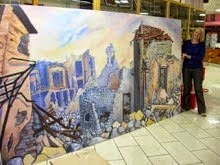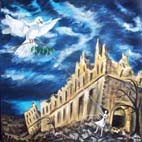
Hold on to Peace - Image courtesy Ira Mitchell-Kirk

Hold on to Peace - Image courtesy Ira Mitchell-Kirk

Saturday, 13 November 2010

They Died, for What?

Tomorrow at Caira is a ceremony for the 20,000 German soldiers who lie, six to a headstone, on their bleak conical hilltop near Cassino. Two days ago it was Remembrance Day, with ceremonies in far-flung places, and more to come tomorrow, Sunday. It is a time to remember all soldiers, and civilians too, and consider that there are no winners in war. The surviving soldiers were victims too, and societies continue to suffer from events that happened more than 65 years ago.

I was browsing "Remembrance Day" and Google produced a Canadian story (click here) typical of scenes all over italy.

Once Armistice Day, and renamed after WWII as Remembrance day, the moment of the 11th hour of the 11th day of the 11th month each year is often commemorated on the Sunday closest to the 11th of November. This link has a comprehensive coverage of the history of the day, written for children. Please note the section added in grey, the text being:
We will remember all .....

Sadly, due to the current intensive operations, the names of many young men and women are now being added to war memorials throughout the land.

We give thought also to the many who are injured but, due to the miracles of modern medicine, are increasingly surviving with horrific injuries.

So, on Remembrance Day, we remember these people as well as those from the two great wars.


***


The challenging sculture by Dave Fowell asks what the civilians of Cassino would think, if they returned to look at the world now. Have we achieved the peace that "we" were fighting for when they lost their lives? Artists exhibiting in Legato had differing opinions.

Dave Fowell at Legato, Italy 2010 from Nicola Blackmore on Vimeo.

Dave Fowell suggests that nothing has changed, but argues that war is not the way to make changes for the better, while Averill Stuart-Head believes that soldiers able to return 65 years later would be satisfied that gains had been made and that the younger generations have better lives because of their sacrifices.

Quilted wall hangings by Averill, "Postcards to Peace" and "Doorways to Peace".


Averill Stuart-Head at Legato, Italy 2010 from Nicola Blackmore on Vimeo.

Averill speaks about her work and the soldiers who lost their lives.

Averill says that "Peace is so fragile, and we have to look after it". How easy it is to forget that, and how tragic the consequences when we do.

Works below: Collages by Averill, "Fragments of Peace"

Friday, 5 November 2010

Behind the Scenes


Legato (Italy 2010) is now all in boxes, packed ready to return to New Zealand. Some work is already safely back in New Zealand, so my sincere thanks go to the artists who took work back with them, some also taking work for others. Some is in the post, some has been posted and bounced back to me from customs, and other works are waiting until the intricacies of exporting artworks can be negotiated - that is, until I can get it all signed off in Rome.

Some generous artists have decided to donate their works to public spaces in Italy, and as soon as the madness of olive picking is over I will place these works. It's not only my own olives causing hold-ups, but the whole region slows down as people return to the countryside to make wine or pick olives. Frustrating perhaps for outsiders, but it is part of the charm that is Italy. You can cross hundreds of years in a day, if you happen to pass a woman carrying her supplies on her head, or an old man leading a mule laden with firewood up cobblestone paths, then look in on an oil press where the latest of technology is gleaming next to cane baskets of olives. I need to talk to the vice-mayor about placing some of the works, but he happens to own the local olive press... pian-piano, as they say here, or (in NZ) "good things take time".

Next week I should be back at my own computer, and luckily my data was salvaged and survived the reformatting of the hard drive. Then I will be able to access more readily the photographs and data I need for this blog.

In the meantime, above are more photos of Janice Corbishley's work which went "on location" to the restaurant at La Locanda del Castello for an evening a few weeks ago, before it was safely delivered home to New Zealand by a travelling artist.

Monday, 4 October 2010

Legato in New Zealand

The new Wallace Gallery, Morrinsville, will host Legato in 2011. The opening event will be Friday 18th February, and the exhibition will run until 16 March.

Before then, though, there are still works to be written about for this blog, and a new brochure to be compiled.

Each time I am ready to take the works down from the wires I get word that someone else is coming to see the exhibition. This weekend it was an Italian family of five, who were particularly moved by the watercolours by Sarah Scott. These powerful works were also appreciated by members of the New Zealand group who visited during the week. The paintings by Susan Edge also drew questions and comment as the Italian viewers appreciated the quality of the paintings and sought to understand the meanings behind the compositions.

The Kiwi visitors were so interested in the work and the history of the exhibition space and the battle of Cassino, and asked so many interesting questions, that I forgot to take photographs of the group in the exhibition.

A recurring theme coming up in discussions here, being volunteered by people who visited Legato in Cassino, is the passion and emotion in the paintings. Quite clearly the balance of works, the varied approaches, and the emotional links to the works is being read well by the Italian viewers. While a few works are standing out as being the most powerful, poignant or memorable for visitors, it is the diversity that creates a cultural richness in the exhibition.

Thursday, 23 September 2010

On their way home.


One of the most admired works in Legato is on its way back to New Zealand, travelling as precious hand luggage. This beautiful bust by Janice Corbishley is a fine example of the interweaving of memory, emotions, aesthetic appeal, and expert skills. More detail can be seen here on Facebook.

What has been interesting with this piece is that inevitably people who have been drawn to the work have also read every word of the text and the artist's biography, and I am sure will remember the link between the artist's uncle and the battles here in Italy.

If you are interested in seeing or commissioning more of her exquisite work Janice may be contacted through her website Mosaic Heirlooms or at the Red Peach Gallery.

Next Tuesday is the last day of the exhibition in Italy, and then other works begin to wend their way home.

Sunday, 12 September 2010

Tea, Peace and Legato.

This week we have been remembering "9/11". It is sobering to think how much time has passed since then with so little change in our politics and attitude to war.

Is war inevitable? I don't believe so.

If every government were to cut its military and defence budgets by half and contribute that half to peaceful works, to improving living conditions and to promoting cultural exchange and understanding, that must make a positive change over time.

If you think that this is too idealistic and that we can't make a difference, read Greg Mortenson and David Oliver Relin's Three Cups of Tea. One peace-loving man achieved what successive govenments have failed to do.

The text on the back cover of my copy of Three Cups of Tea reads:
"Here (in Pakistan and Afghanistan), we drink three cups of tea to do business; the first you are a stranger, the second you become a friend, and the third, you join our family, and for our family we are prepared to do anything - even die." Haji Ali, Korphe Village Chief, Karakoram Mountains, Pakistan.

In 1993 a mountaineer named Greg Mortenson drifted into an impoverished Pakistan village in the Korakoram mountains after a failed attempt to climb K2. Moved by the inhabitants' kindness, he promised to return and build a school. Three Cups of Tea is the story of that promise and its extraordinary outcome. Over the next decade Mortenson built not just one but fifty-five schools - especially for girls - in the forbidding terrain that gave birth to the Taliban. His story is at once a riveting adventure and a testament to the power of the humanitarian spirit."


*****

Peace is not merely a distant goal that we seek, but a means by which we arrive at that goal.” - Martin Luther King Jr.

*****

Legato has almost finished in Italy for 2010. The last group of 30 (New Zealand) visitors is booked to visit the gallery on 28 September. The following day I will close the exhibition and make changes in the gallery. I will miss the Legato works, which I wont see again until they are hung for the New Zealand version of Legato in February 2011. Some works have sold, going to New Zealand and Italian owners. Some are already back in New Zealand, and others are about to be on their way.

October will see in the huge task of getting the remaining works packed, transported to Rome, then re-packed, signed off and sealed in front of customs so that they can be shipped back to New Zealand. While this is happening, Canadian and selected New Zealand artists are already planning their works for the 2011 Legato (Italy).

I am very pleased that the New Zealand version of Legato in February will also include works that didn't travel to Italy for 2010. Works by Lisa Allen, Glenda Kane and Dave Roy will bring different dimensions to the exhibition in the New Zealand venue. Lisa and Glenda are among the artists/writers who have accepted an invitation to exhibit in Cassino in May 2011.

Wednesday, 4 August 2010

Word of Mouth - and a Challenge.

Legato continues to spread its message. Despite the extensive newspaper, internet and television advertising in the province in April and May, the ongoing interest in Legato continuing into August proves that the best advertising is always word of mouth. Visitors are continuing to book appointments to see the exhibition over the relentlessly hot summer, and I am sure that is not because the gallery is a cool oasis in a scorched land. Recently while in New Zealand I received a phonecall from Italy, from a repeat visitor who had requested another viewing of Legato and wanted to comment on the different emotional power of the exhibition in the new venue.

Here in New Zealand three veteran soldiers looked at the exhibition photos and remembered, chatted, discussed many aspects of their time in Italy, and expressed their appreciation of the Cassino exhibition. Fingers lingered on the photograph showing Merv Appleton's work, the grave marked with the rifle having personal meaning for each of them.

A caller from Wellington shared with me comments from the Maori community who were grateful that their fallen were remembered in the exhibition. And so it goes on. It is now almost three months since the opening and it is still being discussed both in New Zealand and in Italy.

Another visit, where friends were talking about an article in the Waikato Times featuring Sarah Scott's contribution to Legato, saw a very animated and wide-ranging discussion about war, peace, and the current situation in Afghanistan. Dave Fowell's work was the most appropriate to discuss in that context, and it continues to spread its message from its lofty home in the historic Italian village. The conversation was passionate, and the word that stays with me from that conversation is "avarice". Our hostess very emphatically attributed the power struggles causing conflict to greed, unequal distribution of resources and love of power.

Now that New Zealand has lost a soldier in Afghanistan on active duty it is timely to remind ourselves that commemoration and respect is not enough. To truly honour our fallen we must not allow their sacrifices to be in vain. Those artists who choose to work for peace must make that step, from the exhibition at Cassino, to "making work that reflects today's conflicts, today's victims, today's political status." (author, Legato depliant, 2010). One "artist" doing exactly this is Lucy Adlington, in her novel for teenagers based on the Battle of Cassino, Burning Mountain. Others include New Zealanders Glenda Kane and Lisa Allen with their sensitively illustrated and poignant story, Anzac Day Parade. These artists and writers are using their time, talents, skills and creativity with real purpose, and in doing so are truly making a difference.

Another book that must be mentioned is Greg Mortenson's Three Cups of Tea. One person with drive and vision really can change lives.

Wednesday, 7 July 2010

An Emotional Space

Visitors to Legato in the more intimate space in Roccasecca are finding it a very moving experience. Sunday evening was busy with 120 visitors to the gallery in four hours, the last couple leaving just after midnight. Yesterday a visitor was moved to tears as soon as she entered the space, and she continued her perusal of the works with tears and tissues. Other visitors were overheard debating the respective roles of men and women in war-mongering and peacemaking. All are requesting translations of the English text that is in some of the paintings, or, if they can read the English, are translating it into Italian for their companions.

The smaller number of works in each of the five viewing spaces allows visitors to pause and reflect more, often going around each space more than once, instead of being carried along by others as they sometimes were in the Cassino venue. Katherine Batchelor's "Specimens of War" holds the viewers for long periods of time as each dish is viewed and questions asked and answered.

The two more whimsical of the works by Susan Edge, along with the bright abstract poppies by Gail Boyle, are displayed in the entrance foyer outside the exhibition area. Here they seem to be taken more seriously, the meanings perhaps being more accessible when away from the more sombre works.

New Zealand medals and photographs linking New Zealand to a Roccasecca family were on display for the two days of the festival, but have been returned to their owner again. Works by Cath Sheard and Lisa Taylor-King are studied intently by men who ask if the soldiers in the photographs survived the war. Perhaps there is a greater sense of connection for the viewers when they can see real faces and families, a reminder of the very human tragedy that war is. As Jose Narosky has said, "In war, there are no unwounded soldiers".

Private viewings outside "gallery hours" are keeping the volunteers busy turning on lights and music, lighting candles and answering questions in a mixture of English and faltering Italian. The next week will bring visitors from a war museum in another region. They have booked to visit the exhibition with their visitors from Scotland.

My apologies for not posting the new photos and videos yet but the local internet connection was lost when a heavy storm hit the town. I will post them at the next opportunity.