Hold on to Peace - Image courtesy Ira Mitchell-Kirk

Hold on to Peace - Image courtesy Ira Mitchell-Kirk

Friday, 12 April 2013

A New Venue


This year Legato will be hosted by the Cassino Comune in the Sala Restagno, in the "city hall." While this is a smaller display area, it will be the centre for many meetings and discussions regarding the commemorations of the battles for Cassino so I am hopeful that it will be a popular and accessible venue.

Smaller works will be displayed in the exhibition window of the Banca Populare del Cassinate, in Corso della Replublica. These works will be seen by a much wider audience as passers by in this major shopping street will have a chance to view them on a daily basis.

I am sincerely grateful for the support of the Comune di Cassino, Cultural Assessore Danilo Grossi, and Pro Loco Cassino, and for the use of their display area I thank the Cassino branch of the Banco Populare del Cassinate.

Above: Untitled acrylic on canvas, 2012, by Kay de Lautour. 
One of a series of four paintings. 

Thursday, 3 January 2013

Legato 2013

The new year brings into focus many things; for Legato it is a time to confirm artists and begin to juggle in my mind the available exhibition space with the vastly different works that will be in Cassino this year.

Receiving day for works is 16 May (or prior to this date by arrangement) and the exhibition will be hung on Friday 17th. The exhibition will be open the weekend of 18th and 19th of May, and will continue until Friday 31st May.

As curator, this is the exciting part of organising an international exhibition. Sometimes things change so plans can only be tentative. This year it is likely that the works I was expecting from Canada will still be touring in Canada, so the featured artists will be a weaver from New Zealand, joined by a painter and a mixed media artist. Other returning New Zealand artists have been confirmed, as well as new artists from Italy.


One of the artists newly confirmed for this year is Ira Mitchell-Kirk, whose work is the image always at the top of this blog. This work by Ira, Hold on to Peace, was the first image I received by email in Italy for the first Legato exhibition. The fragility of the girl who is tenaciously "holding on to peace" seems to say that you do not need to be big, powerful or wealthy to make a difference. Each one of us can maintain a positive link to a benevolent peace in any form, be it international efforts under the image of the metaphorical dove or simply a smile between peoples of different nations and beliefs. International Peace begins with each one of us, and spreads out through our friends and families, into politics, and finally between nations.

The first exhibition, in 2010, was solely of New Zealand art with "New Zealand" artists from Italy and Germany exhibiting to represent their countries of origin and their new home, New Zealand.  Thank you again to Margherita Giampietri, Francesca Gallo and Beate Minderjahn for your generous contributions and for being wonderful artists and ambassadors in the spirit of Legato.

Artists are also being booked for the 2014 commemorations, marking 70 years from the end of the Battle of Cassino. If you are interested in joining us in 2014 please contact me in the next few months; don't leave it too late as venues will be booked early for this important commemoration.


Wednesday, 22 August 2012

Remembering in Film

I was very impressed by the documentary production entitled "The Phoenix" from Grand Island Films. (Update: sorry, it seems that this link is no longer public.  I hope it becomes available again). This representation of the Battle of Cassino is based on the history of the Benedictine abbey on Monte Cassino, and begins with the ancient Egyptian story of the Phoenix.

It is refreshing to see an informative documentary which is clear, balanced, and talks about history without creating heroes.   There are no winners in war.


Monday, 13 August 2012

Remembering Differently

While watching this video to find something I wanted to quote, I decided that this interview with Margherita Giampietri is well worth sharing again.  I was reviewing her words at around 6 minutes 28 seconds, but her comments about the difference between growing up in post-war Italy and being in a country that was not occupied coincide with another conversation I have been having on Facebook.

Margherita Giampietri at Legato, Italy 2010 from Nicola Blackmore on Vimeo.


Saturday, 4 August 2012

Film and History


MONTECASSINO IN THE CIRCLE OF FIRE 
(Italy, 1946). Directed by Arturo Gemmiti.


There is no "real" history, only constructed history.  That is, apart from the dreadful and indisputable fact that in a war people are wounded and killed.  I don't mean to challenge with that statement, but recent events have set me thinking along those lines again.

When we read something published in a book we generally consider it to be fact.  If an entry on the web is from a reputable site we take it to be correct.  When we see something in a film it leaves an impression that is hard to erase.  How much truth is in what we have accepted as reality is open to debate.

Films such as Saving Private Ryan have become part of the social record of history.  They are creating a new  memory, a new history too.  In terms of raising social awareness they do an excellent job, bringing the "reality" of war to the general public.  But no matter how thorough the research, there is no "reality" in any production.

I return regularly to this quotation from New Zealand artist Michael Shepherd, referenced here.
…every time an action passes there is a memory and thereafter the memory is about the memory of the action. And slowly we have this fine silt, the stuff we call history.
We have many kinds of memory, gap filling memory, compensatory memory, episodic memory to name just a few.  It is well known that six people witnessing the same event will give six different accounts of it.  And so it is with "official and unofficial" history, with articles, books and films.

Now, as the 70th anniversary of the liberation of Cassino approaches (May 2014), we see many documentary makers and film makers scurrying to interview veterans and civilians, to record the memories before they are "lost".  I suggest that the memories are more like fine silt, difficult to capture and elusive in nature.  One veteran said "I can no longer tell what is my own memory and what parts of it are from things I have read or seen on telelvison".  In such instances the memory is the product of somone else's (possibly erroneous) writings or recordings.

A quick "google" shows up many documentaries, including (chosen at random) this one from 1943.  Images in many of these documentaries include staged footage, reconstructions, and of course the editorial bias of the film makers.

Researcher Perry Rowe has dedicated countless time to locating the sites of photographs published as "Cassino" or "near Cassino", differentiating between reconstructions and real footage in "Faking Monte Cassino"  (issue 142, After the Battle). His work is fascinating. Many of the reconstructions were for propaganda films "to support the war effort".

There are not so many films about Monte Cassino, and I have not yet seen the one in the poster above.  The poster was kindly loaned to Legato earlier this year by Alberto Mangiante. Mauro Lottici mentions the film in his article on the website Dal Volturno a Cassino.  He writes:
The film [MONTECASSINO IN THE CIRCLE OF FIRE Italy, 1946. Directed by Arturo Gemmiti] uses a heavy hand toward the Germans, and the velvet glove for the Allies. For the scene of the bombing of the monastery used a model, perhaps the original footage of the destruction was not yet available in Italy.
That it is not based on unbiased fact is clear, but does "unbiased fact" really exist? And, in light of all the divergent "memories" that emerge, is it not better to understand why we feel the need to alter facts rather than be too critical of those individuals who change things in memory to suit their own psychological and emotional needs?


Thursday, 31 May 2012

Colours (and Memory) Never Die


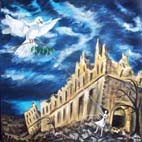
This acrylic and oil on canvas by Rodolfo Losani has drawn much positive comment.  The title is "Mangiare Memoria" and he writes "I colori non muoiono mai, come la memoria va nutrita per non dimenticare il passato".

(Source, website: Rodolfo Losani )
The grey area of the painting represents the brain.  While time passes and life might change, the colours, emotions and memory are nourished and therefore do not fade. 

Contributing Artists at Cassino, 2012


Legato 2012 Cassino, Italy 

For the third Cassino edition of Legato, the Monte Cassino Foundation's international exhibition for commemoration and peace, the artists from New Zealand, Canada and Italy were joined by a new artist from Canada and more Italian artists.  The New Zealand edition planned originally for Christchurch was cancelled after the devastating earthquake of 2011.

Next year the featured artist at Cassino is from Canada, and other international artists have been confirmed for Cassino in 2013 and 2014.

The following list of 2012 artists is from the guide to the works in the exhibition so some names are repeated where the work was hanging in different groupings.  Approximately 50 works by 24 artists were on display.

Entrance foyer and entry panels:

Prof Alessandro Nardone  -  Italy

Francesco Nardi   -  Italy

Ira Mitchell-Kirk  - New Zealand

Kay de Lautour  - New Zealand and Italy

Lorenzo Daniele Corsi  - Italy
 
Dr Danilo Salvucci  - Italy

Gail Boyle  - New Zealand

Raffaele D'Aquanno  - Italy


Side Wall 1:

Susan Edge  - New Zealand

Ann Fletcher  - New Zealand


Regan Balzer  - New Zealand

Bernadette McCormack  - Canada

Linda Dickens -  New Zealand


Kay de Lautour  - New Zealand and Italy

Pamela Barnard  - England and Italy

Margherita Giampietri  - Italy and New Zealand


Pamela Barnard  - England and Italy

Nancy Stevens  - Canada

Merv Appleton  - New Zealand

Peter Stott  - England and Italy


End wall:

Kay de Lautour  - New Zealand and Italy


Side Wall 2:

Sarah Scott  - New Zealand and USA

Alberto Mangiante  - Italy (original poster of the film "Monte Cassino")

Rocco Lancia - Italy


Anna Maria Corsi  - Italy

Agnes Presler  - Hungary and Italy

Sara Antonini  - Italy

Lorenzo Daniele Corsi  - Italy

Rocco Lancia  - Italy


Francesco Nardi  - Italy

Sara Antonini  - Italy

Rudolfo Rosani  - Italy


Dr Danilo Salvucci  - Italy

Gail Boyle  - New Zealand

Francesco Nardi - Italy


Art Book: Anzac Day Parade by Brenda Kane and Lisa Allen,  New Zealand

Reproductions of original wartime diary sketches and watercolour by the late Tom Howes, England

Copies of photographs from New Zealand wartime publications.

Organiser and Curator: Kay de Lautour Scott.

Publicity and opening event: Pro Loco Cassino.