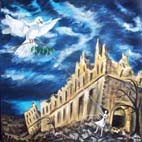
Hold on to Peace - Image courtesy Ira Mitchell-Kirk

Hold on to Peace - Image courtesy Ira Mitchell-Kirk

Friday, 11 November 2011

Ripples Across the Water


In 2010 Ronda Turk travelled to Cassino with her mother, Mary Howan, and other New Zealand artists and supporters, to exhibit with Legato, to visit Italy, to learn more about the Battle of Cassino, and of course to enjoy the wonderful countryside. Ronda and Mary made the most of their time here walking the picturesque hillsides, exploring the villages, enjoying being "local", experiencing as much of Italian culture as they could.

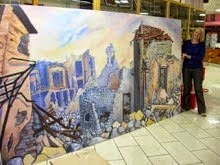
Using her photographs from this trip Ronda painted her impressions of Italy back in New Zealand. She recently won an award for her "townscape" of Roccasecca, this scene being near the Bed and Breakfast L'Ortica where she stayed.

Ronda's research prior to painting for Legato included interviews with veteran Don Hutchins, who served time in Italy. Don was a private with the 25th Battalion and his job was a Dispatch Rider; he also was a runner for about 4 days during the battle in Cassino. He spent two years fighting in Italy with around five months in Cassino. He was wounded later in Rimini, but returned to battle when he was fit enough.

Thanks to the social media of Facebook Michele Di Lonardo of Cassino saw the photograph of Ronda with her winning painting, and contacted her to interview her via Skype. The newspaper article above, published in Cassino in time for Remembrance Day, is the result of this connection.

Thanks to the internet art can certainly make ripples from one side of the world to the other.

Thursday, 10 November 2011

Armistice Day, Remembrance Day, Veteran's Day

(Image taken from Wikipedia)

The clock on my computer has just flicked over to 11/11/2011 and a Facebook photo from New Zealand showed a clock at 11.11 11/11/11.

Today is Remembrance Day for many around the world. It is a day marked by the Commonwealth countries, but also recognised by many other countries throughout the world. It marks Armistice Day, the official end of World War I.

I often think of Australia on this day. Shortly, at the 11th minute of the 11th hour on the 11th day of the eleventh month a ray of sunlight will touch the poignant statue at the Shrine of Remembrance, the War Memorial in Melbourne. Five Australians lie in the cemetery in Cassino. One was a journalist; all were doing what their country asked of them.

Whatever we call it, Armistice Day, Remembrance Day, Veteran's day or Poppy Day, it's time to reflect, to remember.

It is also time to look ahead. Now, as much as we ever did, we need to educate for a culture of peace. Here in Europe I hear disquietening rumblings, of movements that are threatening, of strongly nationalist and militant ideology. We can't relax and ignore them, but must be proactive in reaching out to the young people, making links that will bind countries in peace, not divide them in oppressive actions.

Legato is a small movement, but it is one of many. Together we are a positive force. We never know who we reach, or how we do make change. But change does happen, and positive change through any medium is to be supported and applauded.

*****

Works from Legato 2010 are still finding their way home. Today I packed works that were shown again in the 2011 Cassino Legato, and these will travel to New Zealand shortly. The permanent display in Italy is changing slightly as these works are returned to their owners and new ones are added to the collection.

I visited New Zealand works in the Sora school last week, where the teachers and children were overwhelmed by the generous donation of work that didn't go back to New Zealand. I am delighted to be involved in planning the best placement and use of these works so that they form a central part of peace studies in the school.

Follow-up work from 2010 continues, while planning for new events stretches out to 2014. At the moment the Legato collection is being enjoyed by Polish visitors, and these essential links with Poland are being consolidated as I don't speak Polish and need help with the Polish Legato negotiations.

The Polish cemetery on Monte Cassino is undergoing extensive maintenance work. The trees have been removed and will be replaced, and the damage caused by tree roots repaired. While is appears stark in comparison to when the trees were still there it is also now highly visible, and reminds us of the real cost of war.

One thousand young Polish men did not go home from Cassino. Poland suffered terribly during and after the war. I look forward to working with Polish artists for commemoration and peace.

Wednesday, 21 September 2011

First Canadian Work for Legato

Legato (Italy) May 2011 included this small painting by Bernadette McCormack, who responded quickly to my initial inquiries to artists in Canada. Next year Legato will focus more on Canadian and Italian art.

This work has since been on display in Roccasecca with other works and the small but growing Legato permanent collection. It draws comments from adults and children and is one of the most popular new additions on display. Children seem to know almost instinctively that there is much to read in the work, and find symbolism in it that escapes most adults.

Bernadette McCormack

Sono cresciuta in Canada, una nazione tranquilla. La mia sola esperienza di guerra erano le storie raccontate dai miei genitori del tempo in cui erano bambini a Manila e, per sfuggire alle bombe, durante la seconda guerra mondiale, dovevano inerpicarsi su per la montagna in cerca di un posto sicuro. ll mio secondogenito ha sempre avuto un grande interesse per la storia militare fin da quando aveva sei anni, quindi ha iniziato ad introdurmi agli orrori, alle strategie, ai sacrifici occorsi durante la seconda guerra mondiale. Recentemente siamo stati in Normandia per soddisfare la sua curiosita' e abbiamo visitato le spiagge e I luoghi dello sbarco. Sono rimasta impressionata nel vedere i cambiamenti prodotti dagli anni. i campi verdi, le spiagge ben tenute, pronte per I turisti. Ma so che la terra, cosi' come la gente, ricordano le tragedie della guerra. Questo e' cio' che voglio simbolizzare nei miei quadri usando l'innocenza dei fiori che crescono dentro all'elmetto dei soldati caduti.

I grew up in Canada, a peaceful country. My only experience with the war was the stories my parents told of their time as small children in Manilla, where they had to escape the bombings of the second world war by climbing the mountains to a safer location. When my second son was born, he started to show an intense interest in military history at the age of six years old, and he started to educate me further of the horrors, the strategies, the sacrifices that occurred in the second world war. As he grew, he started to beg me to take him to the province of Normandy to satisfy his interest in the D-Day Invasion. Just recently, in order to fulfill my son's wishes, I found myself accompanying him to the landings and beaches of the D-Day invasion in Normandy. I was impressed with the way the land had renewed itself. The fields were smooth and green, the beaches were clean and flat and ready for sunbathers. But I know that the land, as well as the people, all remember the tragedies of war. I wanted to depict this notion in my painting by using the innocence of flowers growing in a fallen soldiers helmet.

Sunday, 5 June 2011

Abstract Work Colours Vibrate

Italian artist Francesco Nardi balances the three primary colours on a stark white background, creating a tension that resonates but also allows space for calm reflection.*

He writes:
La sintesi operata nel mio lavoro pittorico riguarda soprattutto gli artisti che nel primo dopoguerra operarono negli Stati Uniti con l influenza dei pittori europei. Mi riferisco a Mark Rothko, Jackson Pollock, Sam Francis, insomma alla New York School in generale. Le problematiche affrontate sono le stesse ed il messaggio di pace nell opera esposta resta immutato e latente.

Francesco Nardi

.

*The photograph above does not capture well the dazzling interaction of the chroma intensity used by Nardi in this work.

Monday, 23 May 2011

Return of a "Penny Diver"

Images from Legato, 23 May 2011.
One of the 28th Maori Battalion "Penny Divers," Aubrey Balzer shares his memories of Italy and his message of peace with family and visitors to Legato.


Sunday, 22 May 2011

Sala Pietro Malatesta, Biblioteca, Cassino.

Lunedi 23 maggio 11.00 invitiamo tutti voi a Legato, incontrare con l'artista Regan Balzer e suo zio, soldato veterano Aubrey Balzer.


Legato is in the old picture theatre in Cassino, the building which now houses a Tribunale and a library as well as the Sala Pietro Malatesta, an exhibition space and conference room.

The building is also known as Arcoboleno, which means Rainbow, and was the name of the picture theatre. Visitors used to the subdued palettes of the Italian artists might well think that they have walked under a rainbow when they enter the space these days. Collectively the paintings in Legato bring light, brightness and energy into the space. A different culture shines through.

Legato has already hosted many interested visitors and at least one very interested gathering of professional people meeting in the space. Monday is the official "launch" where you can meet with artists Lois Wine, Kay de Lautour and Regan Balzer, and Regan's uncle Aubrey Balzer who is a veteran who served with the Maori Battalion in Cassino.

Wednesday, 18 May 2011

Featured Artist: Regan Balzer


Legato is now open at Sala Pietro Malatesta, Biblioteca Comunale, Cassino, Italy.

Ore/opening times: 8.30 - 13.00, 15.00 - 17.45.

Featured artist: Regan Balzer (NZ). Also included are works by other artists from New Zealand, Italy, Canada and Germany.

Regan Balzer

Il mio lavoro come artista e' centrato sulla mia esperienza di donna Maori che vive in Aotearoa (nome originale Maori della Nuova Zelanda n.d.t.)

Oggigiorno e che viene ispirata dal passato degli avi.

Esibire i miei quadri in "Legato" ha molto significato per me perche' i miei antenati sono molto importanti per me. Derivo da loro, sono sangue del loro sangue, il mondo in cui vivo e' stato forgiato da loro. E' un onore prendere parte a un evento in cui loro vengono riconosciuti e le loro azioni del passato vengono valorizzate.

Mio nonno era il maggiore di tre fratelli, perse il fratello piu' giovane, Oswald, in Italia durante la seconda guerra mondiale, mentre lui rientro' In Nuova Zelanda dopo essere stato gravemente ferito fuori Cassino. A causa delle conseguenze delle sue ferite la qualita' di vita cambio' drasticamente per lui.

Ormai mio nonno e' deceduto, ma ho la fortuna di aver passato del tempo con suo fratello, mio zio Aubrey Balzer, ormai novantenne. E' incredibile la sua capacita' di ricordare gli eventi della campagna di guerra italiana, come fosse oggi! I miei quadri sono stati ispirati dai suoi ricordi, momenti che non posso comprendere fino in fondo, momenti in cui sono stati persi dei cari e una intera generazione di capi Maori.

L'antica tradizione maori della scultura su legno ci ha tramandato con le immagini, con il linguaggio visivo, la cultura maori. I miei dipinti incorporano l'immaginario, la narrativa e le forme della tradizione scultorea maori tradotti sulla tela. I colori della regione geotermale dove sono cresciuta (Rotorua n.d.t.).
Sono diventati la base della dia tavolozza. A causa dell'effetto dello zolfo sull'ambiente circostante, i colori sono fortemente contrastanti, verde lussureggiante e giallo intenso, blu glaciale e rosso acceso con un risultato assolutamente affascinante. Quando creo un quadro uso di proposito colori forti, contrastanti, li stratifico creando un ventaglio di sfumature. Gli strati di colore e le forme scolpite dall'immaginario sulla tela trasportano la mente dello spettatore.
Cosi' come le voci di un coro muovono l'animo, il proposito del mio lavoro e' quello di muovere l'animo verso la rivitalizzazione della conoscenza tradizionale Maori, verso la tramandazione della narrativa storica, attraverso una sinfonia visuale di colori e forme.

Nel momento in cui l'immagine comincia a danzare nell'interazione di linee, luci e colori so che il quadro e' finito.

Uso il pennello e incido con la pittura, abbracciando la nostra ricca storia maori e condividendone con gli altri il significato che ha nella mia vita.

Le grandi cose cominciano a piccoli passi e il successo si conquista con la forza che mettiamo nel raggiungere i nostri obiettivi.

'Whaia te iti kahurangi, ki te tūohu koe, me he maunga teitei'


Regan Balzer

The themes in my work are related to my experiences as a Māori woman living in Aotearoa and a modern world.

Inspired by my ancestors...

Exhibiting in Legato is meaningful to me because my ancestors are important to me. It is their blood that I carry within me and it is their deeds that have shaped the world I live in today. It is an honour to exhibit in a show that acknowledges them and the actions of their day.

My Grandfather was the eldest of three brothers. I lost my great Uncle Oswald (the youngest) in Italy during World War II. My grandfather, severely injured just out of Cassino, returned to New Zealand, the injury changing his quality of life forever. Although my grandfather has now passed away, I have been lucky enough to spend some time with the sole surviving brother, Aubrey Balzer, now 90 years old. It is amazing how Aubrey has been able to recall the events of the Italian campaign with such clarity, as if he was there only yesterday (not the 70 years ago that it actually is). My paintings have been inspired by his recollections of a time, a time that I cannot comprehend, but a time when we lost not only family, but we also lost a generation of Maori leaders.

Customary Maori woodcarving is an ancient practice that has been responsible for retaining a wealth of imagery and visual language in the Maori culture. My paint work incorporates imagery, form and narrative from Maori woodcarving and translates these onto a two dimensional surface of paint The geothermal district, of which I was raised, becomes a base for my colour palate. Through the effects of the sulphuric environment, contrasting colours constantly appear side by side, lush greens with titillating yellows and chilly blues with fiery reds, all of which look absolutely stunning.

When creating a painting, I purposefully select bold, contrasting colours, building this colour in layers, creating a symphony of shades. The layering of paint and carved form imagery on the canvas allows the viewer to go on a journey. Just as the voices of a choir stir the soul, the ultimate goal of my work is a stirring of the soul that speaks to the revitalisation of customary Maori knowledge and the retention of historical narrative, through a visual symphony of colour and form.

Once the painting begins to dance through the interaction of line, colour and light I know it is then finished.

I use my paintbrush and I carve with paint, embracing our rich Maori history and sharing its significance in my life with the world.

Great things begin with just a single small step and success comes from the drive to move forward to reach your goals.


‘Whaia te iti kahurangi, ki te tūohu koe, me he maunga teitei’