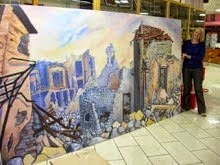
Hold on to Peace - Image courtesy Ira Mitchell-Kirk

Hold on to Peace - Image courtesy Ira Mitchell-Kirk

Friday, 30 April 2010

Timeless Images

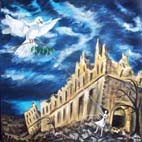
"Santo Benedetto e le Columbe di Pace"Some of the artists involved in this exhibition have taken the opportunity to produce work different from their usual art. Artist Susan Edge, better known for her colourful, rather whimsical and always cheerful naive art, has used a recent photo of the statue of St Benedict and an ancient painting of St Benedict as her source (below) to produce a work (above) that is both old and new.

The statue is in the entrance cloister of the Abbey, and represents St Benedict in a moment of joyous rapture as he goes to meet God. St Benedict was aware that the moment of his death was approaching, and asked to be taken to his favourite cloister where monks supported him as he awaited death.

Susan has created a younger St Benedict, sharing joy with the doves, the symbol of peace. Doves do often waddle around in this cloister, completely unphased by the thousands of visitors who pass through every year.


(The doves above really did arrive one by one... like me choosing to stay in the shade rather than go out into the sunny grassed area by the statue where they usually congregate).

Thursday, 29 April 2010

A Sense of Closure

McEwan Grave, Western Desert.

Oil on canvas, painted from the descriptions told to him by veteran soldier Watty McEwan. This painting has helped to bring a family member home, metaphorically, in the absence of wartime sketches or photographs.
Thanks to artist Merv Appleton for permission to share this work. The recipient, in his 90s, says that this has helped to bring some peace and a sense of closure to his terrible loss, after nearly 70 years of a daily sense of loneliness.

Other acts of closure are being made, with a work commissioned in New Zealand especially to be shown in Italy and then returned to the family (artist Sharlene Schmidt), and Margaret Piggott will be returning a portrait work to New Zealand after it has been shown in Italy, at the request of the owner, to honour a family member from the Maori Battalion.

Please see this previous post for more details.

Wednesday, 28 April 2010

A Veteran's Story

In light of my closing comments in the previous post it was wonderful to find this in my email in-box this morning.

It is never too late to make a difference in someone's life.

How does the expression go? At the end of the day, when we look back, the only things that we regret in life are the things that we didn't do.

Another maxim that I read recently claimed that when we look back on our lives we don't remember the famous, the people with money, the people with power, the people with titles. We remember the people who made us feel good about ourselves, the people who made a difference to us personally.

Are we too busy to listen, and share stories? Or do we care enough, and make a space to share?

Monday, 26 April 2010

Anzac Weekend


This year I couldn't make it to the Commonwealth cemetery on Anzac Day because of other obligations. Instead I remembered the soldiers with local people who were keen to share their memories of the friendly and helpful young men from New Zealand. "Kiwis, we called them", said one. As I heard their stories I was very proud to be a Kiwi too.

Saturday saw me talking with a friend who remembers well the war in Roccasecca. Her large home was one of three owned by the family and taken over by the Germans to house a whole troop. While they (and all around them) eventually lost all their livestock and produce to feed the troops, in the early stages when Italy was on the side of the Axis powers it was a happy occupation. The soldiers played with the children, and, while far from being a normal life, it was relatively peaceful and safe for the children.

When Italy changed sides, so did the treatment of the family change. The women and children, while not sexually violated, were treated harshly and my friend, at the age of 5, was expected to do farmwork far beyond her capabilities to provide food for the soldiers. She says it still hurts when she thinks of how the soldiers she trusted, who carried her on their shoulders and played with her every evening, became tyrants shouting orders and treating her mother and the children so badly.

That's what war does to people. The young German soldiers, just teenagers towards the end of the war, were victims too.

Other troops were commented on but the Canadians and the Kiwis were the ones held in fondest regard. They were "people just like us" she said, "they didn't think they were better than us".

Sunday lunchtime was spent talking to an exhibitor at the local exhibition, listening as he shared his memories of occupation and the good things he knew about Kiwi soldiers. New Zealanders are well known here for their generosity with food.

Many of this gentleman's stories (he is now 81) had both of us near tears. He finished with a story about a clever pig to make me laugh. His mother had eleven children, and all their food and resources had gone to the German troops except a hidden cow and a pig. Money had no worth, and a little oil that they had buried was their currency for grain until that too was taken from them, and only mountain grass and milk was left to feed the family.

The cow was hidden in a dark underground space below the kitchen. The only way down to it was through hidden stairs from the kitchen itself. How they got the cow down there in the first place I simply couldn't imagine. The milk was all that the family had, and this was mixed with a coarse red maize crushed to make a meal that fed the family, or boiled for the babies. The mother had lost her own milk for feeding the babies because of the lack of food. Sometimes the maize that the oil was exchanged for was mouldy and inedible.

The pig was walled in, in a crumbling barn away from the house. Manure from the precious cow was mixed with water and painted on to the new wall to make it look old. The ruse worked. The smelly wall was never discovered or breached. There was no door into the space. There was what I think might have been a grate to allow air and light, and to drop food in, and this was covered when soldiers came. Apparently every time the family members came out to feed the pig it snorted and grunted as soon as it heard them, impatient for it's tucker. When German soldiers with their noisy boots approached the covered feeding hole the family collectively held it's breath. So, apparently, did the pig. In this case German searches were unsuccessful. The pig was never discovered.

Here there are so many stories that need to be told. Not to re-write history books, but to allow the people to express the grief and loss that still wells up inside them as they look at the past. It is the same in New Zealand. Let's listen well, and try to understand what makes us the people we are. New Zealanders. The "passionless people?" I think not. Or if we are, as Gordon McLaughlin suggested in 1979, the passionless people, maybe that is how we became, after the war. Perhaps there was a reason to be so, and now is the time to reverse that shutting down of emotions and remove the mask that says "Leave me alone, I'm OK".
Friday, 23 April 2010

Returning to a Different Society

Among my incoming emails is this comment: "...and those who fought so bravely and returned to a different society. A different kind of battle". (See below for context).

I have heard veterans speak with a little bitterness about returning home to a changed society, expected to fit in, and having to be taught by younger men who were at school while the soldiers were in the battlefield. Those at "home" had work, earned salaries, and had moved ahead while the returned soldiers came home without work, having been paid only a small allowance while they were away, and had to find their way back into a society that did not understand what they had been through. For some, having experienced trauma, and seen sights that no young person should ever have to see, they then had to take instruction and correction from "school kids".

One veteran said "We couldn't talk about it. You don't want your wife and children to know how terrible it was. Only the returned soldiers from the First World War had any idea of what we had been through. And you felt guilty that you had survived. When you saw someone who had lost their sons, you couldn't look at them. You didn't want to be there. It wasn't easy, coming home".

That there is still a huge legacy from this war in New Zealand is evidenced by the requests artists have had. Margaret Piggott writes:
".The Maori connection... I painted the transition of the soul after death, announced by fantails and passing through the Pohutakawa tree and along the land to Cape Reinga where it then goes through the roots of the Pohutakawa to the legendary "Hawaiki" I painted a portrait of Teresa with her whakapapa down the side. This work is not for sale. When she heard about this exhibition she insisted that this painting be shown as a tribute to her late father, who fought in Cassino and was a sniper in the Maori Battalion. He stands behind her. He was one of the youngest, having lied about his age and was so quick on his feet that he returned. Most snipers didn't. ... Teresa has many relatives who are watching this exhibition with interest and see it as an ideal way to remember fallen loved ones and those who fought so bravely and returned to a different society. A different kind of battle."


Artists, by sharing your stories, and talking with family and veterans, you are providing a much needed service in our country. We remember those who fell, but too often we forget that those who survived have been carrying a huge amount of grief, dreaming horrific images, and left alone to deal with a past that needs to be faced and put to rest, not buried inside them where it remains a sorrowful burden.

Merv Appleton's painting for Wattie McEwen (presentation recorded by TV3) must surely be one of the treasures that has come from this exhibition. I understand that the painting below is the one that moved the veteran to share with Merv the story of finding his brother's grave.

Thursday, 22 April 2010

The Futility of it All

During a pause on our path along the Gustav Line researchers shared with us photographs which highlighted both the futility and the human aspects of war. In this photograph (below) German and Allied combatants share cigarettes, conversation and pose for a photograph. On the back of the photograph it tells that this was taken during a pause requested by the Germans to retrieve their dead.
The numbers were so great that the Allies lent the Germans stretchers, which were duly returned to them at the end of the operation. Then, all this done in friendly and respectful fashion, both sides continued to shoot to kill.

Remember

Today I saw this link, Ode to the Fallen, ANZAC DAY, on the Maori Battalion Facebook page. The images are a grim reminder of the realities of war.

***

Remember that there is open access to the Legato fan page on Facebook, where photographs are uploaded more frequently than on this blog.