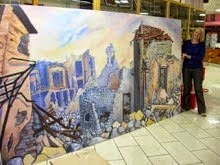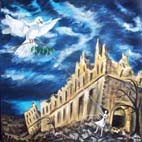
Hold on to Peace - Image courtesy Ira Mitchell-Kirk

Hold on to Peace - Image courtesy Ira Mitchell-Kirk

Wednesday, 18 May 2011

Featured Artist: Regan Balzer


Legato is now open at Sala Pietro Malatesta, Biblioteca Comunale, Cassino, Italy.

Ore/opening times: 8.30 - 13.00, 15.00 - 17.45.

Featured artist: Regan Balzer (NZ). Also included are works by other artists from New Zealand, Italy, Canada and Germany.

Regan Balzer

Il mio lavoro come artista e' centrato sulla mia esperienza di donna Maori che vive in Aotearoa (nome originale Maori della Nuova Zelanda n.d.t.)

Oggigiorno e che viene ispirata dal passato degli avi.

Esibire i miei quadri in "Legato" ha molto significato per me perche' i miei antenati sono molto importanti per me. Derivo da loro, sono sangue del loro sangue, il mondo in cui vivo e' stato forgiato da loro. E' un onore prendere parte a un evento in cui loro vengono riconosciuti e le loro azioni del passato vengono valorizzate.

Mio nonno era il maggiore di tre fratelli, perse il fratello piu' giovane, Oswald, in Italia durante la seconda guerra mondiale, mentre lui rientro' In Nuova Zelanda dopo essere stato gravemente ferito fuori Cassino. A causa delle conseguenze delle sue ferite la qualita' di vita cambio' drasticamente per lui.

Ormai mio nonno e' deceduto, ma ho la fortuna di aver passato del tempo con suo fratello, mio zio Aubrey Balzer, ormai novantenne. E' incredibile la sua capacita' di ricordare gli eventi della campagna di guerra italiana, come fosse oggi! I miei quadri sono stati ispirati dai suoi ricordi, momenti che non posso comprendere fino in fondo, momenti in cui sono stati persi dei cari e una intera generazione di capi Maori.

L'antica tradizione maori della scultura su legno ci ha tramandato con le immagini, con il linguaggio visivo, la cultura maori. I miei dipinti incorporano l'immaginario, la narrativa e le forme della tradizione scultorea maori tradotti sulla tela. I colori della regione geotermale dove sono cresciuta (Rotorua n.d.t.).
Sono diventati la base della dia tavolozza. A causa dell'effetto dello zolfo sull'ambiente circostante, i colori sono fortemente contrastanti, verde lussureggiante e giallo intenso, blu glaciale e rosso acceso con un risultato assolutamente affascinante. Quando creo un quadro uso di proposito colori forti, contrastanti, li stratifico creando un ventaglio di sfumature. Gli strati di colore e le forme scolpite dall'immaginario sulla tela trasportano la mente dello spettatore.
Cosi' come le voci di un coro muovono l'animo, il proposito del mio lavoro e' quello di muovere l'animo verso la rivitalizzazione della conoscenza tradizionale Maori, verso la tramandazione della narrativa storica, attraverso una sinfonia visuale di colori e forme.

Nel momento in cui l'immagine comincia a danzare nell'interazione di linee, luci e colori so che il quadro e' finito.

Uso il pennello e incido con la pittura, abbracciando la nostra ricca storia maori e condividendone con gli altri il significato che ha nella mia vita.

Le grandi cose cominciano a piccoli passi e il successo si conquista con la forza che mettiamo nel raggiungere i nostri obiettivi.

'Whaia te iti kahurangi, ki te tūohu koe, me he maunga teitei'


Regan Balzer

The themes in my work are related to my experiences as a Māori woman living in Aotearoa and a modern world.

Inspired by my ancestors...

Exhibiting in Legato is meaningful to me because my ancestors are important to me. It is their blood that I carry within me and it is their deeds that have shaped the world I live in today. It is an honour to exhibit in a show that acknowledges them and the actions of their day.

My Grandfather was the eldest of three brothers. I lost my great Uncle Oswald (the youngest) in Italy during World War II. My grandfather, severely injured just out of Cassino, returned to New Zealand, the injury changing his quality of life forever. Although my grandfather has now passed away, I have been lucky enough to spend some time with the sole surviving brother, Aubrey Balzer, now 90 years old. It is amazing how Aubrey has been able to recall the events of the Italian campaign with such clarity, as if he was there only yesterday (not the 70 years ago that it actually is). My paintings have been inspired by his recollections of a time, a time that I cannot comprehend, but a time when we lost not only family, but we also lost a generation of Maori leaders.

Customary Maori woodcarving is an ancient practice that has been responsible for retaining a wealth of imagery and visual language in the Maori culture. My paint work incorporates imagery, form and narrative from Maori woodcarving and translates these onto a two dimensional surface of paint The geothermal district, of which I was raised, becomes a base for my colour palate. Through the effects of the sulphuric environment, contrasting colours constantly appear side by side, lush greens with titillating yellows and chilly blues with fiery reds, all of which look absolutely stunning.

When creating a painting, I purposefully select bold, contrasting colours, building this colour in layers, creating a symphony of shades. The layering of paint and carved form imagery on the canvas allows the viewer to go on a journey. Just as the voices of a choir stir the soul, the ultimate goal of my work is a stirring of the soul that speaks to the revitalisation of customary Maori knowledge and the retention of historical narrative, through a visual symphony of colour and form.

Once the painting begins to dance through the interaction of line, colour and light I know it is then finished.

I use my paintbrush and I carve with paint, embracing our rich Maori history and sharing its significance in my life with the world.

Great things begin with just a single small step and success comes from the drive to move forward to reach your goals.


‘Whaia te iti kahurangi, ki te tūohu koe, me he maunga teitei’

Sunday, 15 May 2011

Watercolour Works for Italy

Italian-born New Zealand artist Margherita Giampietri continues to challenge with her work for Legato. For the New Zealand edition of Legato Giampietri painted "Lambs to the Slaughter" (in the spotlight area of the photograph below) and has created a very different image for Cassino.

Cassino work:

This work expresses universal emotions and allows viewers to interpret the scene according to their own experiences.

Saturday, 14 May 2011

New Artworks Arrive in Cassino

Ero una bambina quando scoppio' la guerra, ma ricordo con precisione i momenti in cui sedevo di fianco ai miei genitori mentre ascoltavano le notizie dal fronte alla radio.
Ricordo la lunga lista di nomi che veniva letta: chi era morto in azione, chi era rimasto ferito, e peggio ancora chi era disperso.
La mia mente bambina si chiedeva se questi poveri giovani provassero la paura e se sarebbero mai stati ritrovati.

Da adulta ho trovato e letto la poesia "To the fallen" ( "Ai caduti") di Lawrence Binyon e la forza di quelle parole mi ha commosso profondamente.
Si puo' solo sperare che forse in un futuro gli uomini giungano alla conclusione che la guerra non e' "la soluzione".

Lois Wine (2011)


Fabric artist Lois Wine has arrived in Italy with her quilt commissioned especially for Cassino 2011. Lois has hand-painted the silk used in this work. Around the borders are scenes from the Cassino area, and the poppies well known in memorial works feature in the centre.

Lois writes: I was only child when war broke out, but I vividly remember sitting beside my mother and father as they listened to the war news on the radio. The long list of names being read out, those who were killed in action, others wounded but worst of all were the ‘missing in action’ names. I wondered in my childlike way if those poor men were really scared and if they would ever be found.

When I was an adult I found the poem ‘To the fallen’ by Laurence Binyon and the poignancy of that poem brought tears to my eyes. One can only hope that maybe in the future, mankind will eventually come to realise that war is not the answer.

Thursday, 28 April 2011

Another ANZAC Day Passes

The poppies are in bloom again, growing tall and free in the fields or tightly bound in their plastic bases in memorial gardens. The difference is striking. So too is the difference between a young man full of the joy of life and one lying forever in a foreign land.

This year the New Zealand Embassy hosted the Anzac Day service at the Rome War Cemetery. The day was damp and overcast, fitting the mood in the small but interesting cemetery. There are not many New Zealand soldiers buried here, but those who are there had many visitors and were remembered along with those who are still risking their lives fighting in conflicts today.


Masters of Ceremonies were Wing Commander Ian MacPherson, NZDF and Chief Petty Officer James Dew, ADF. Prayers were led by Father Paul Martin SM and Canon David Richardson and the reading was given by His Excellency David Ritchie, Australian Ambassador. His Excellency Dr Trevor Matheson, New Zealand Ambassador-Designate (pictured below), gave the address.


The service was traditional, and wreaths were laid by representatives of 19 countries and organisations. The singing, unaccompanied as earlier rain prevented the use of a sound system, was both prayerful and patriotic.

From the opening prayer in Rome on Anzac day 2011 comes this hope for mankind:
"We ask that the liberty, truth and justice which [the fallen soldiers] sought to preserve may be seen and known in all the nations upon this earth".

One phrase in the closing prayer (Canon David Richardson) struck a particular chord with me, praying for "peace among nations, peace in our homes, and peace in our hearts".

The Prayers of Intercession (Father Paul Martin SM) are copied here:

Let us pray for leaders of nations, and for all who are working to promote understanding between peoples, that their efforts may bring about justice, freedom and lasting peace.

Let us pray for those who suffer today as a result of war, terrorism and all forms of violence, that through their suffering we may learn to resolve conflicts without bloodshed.

Let us pray for the men and women of all our countries who have died in war, especially for those who are buried in this place, that their self-sacrificing courage may inspire us to face the difficulties in our time with integrity and goodwill.

Let us remember especially those who this day commemorates, and the contribution they have made to the growth of our nations. May we never forget the ideals for which they have died.

Let us spend a moment in silent prayer asking God for the gift of peace; for ourselves and our families, our communities, and our world.


As I looked at the young piper standing alone behind the cenotaph I wondered how long it would be before he too had to decide where he stood as a peace maker.


Music, like art, is an effective weapon of choice. Music unites and inspires us to seek greater things. It can also be used to unite to draw strength to attack a perceived enemy. I recall a poster from many years ago: "There are no strangers in this world, only friends I have yet to meet". Let music and art always be used to educate, to forge friendships, to promote harmony, to bring about a lasting peace.

Sunday, 10 April 2011

Peace - an Uncommon Concept?

A people sacrificed for peaceful principles recovers its identity and leads by example even in these troubled times:
So deeply committed to their pacifist beliefs and their covenant of peace, that just over 170 years ago, they deliberately refused to abandon their principles in the face of unwarranted aggression, with horrendous consequences. The last "full-blooded" Moriori died in 1933. The Moriori story and Nunuku's covenant of peace, provides a vital message for today's turbulent world.

Peace is not a new concept in the world, just an uncommon one.
(Source: http://www.education-resources.co.nz/)

My next blog post was to be about education for a culture of peace, with particular reference to the nations who have historically claimed to be peace keepers rather than active aggressors in times of war. I watch daily the events unfolding in Libya, and more particularly recently the involvement of peace loving nations who have somehow become caught up in acts of aggression despite their best intentions. Their citizens are quite rightly expressing their concern at what is happening.

It was timely, for me, to receive a comment in response to an earlier post, which brings to the fore this very issue.

As a child going to school in the 1960s I learned about the Moriori people, the peaceful early inhabitants of New Zealand. We were taught that the Moriori people had all but died out, but that their peaceful legacy was to be admired and upheld. The Moriori people, like many other peace makers, suffered for their principles. They were to be remembered and praised, but was left thinking that as a people they were, sadly, doomed. Their recovery as an identifiable ethnic group with a modern identity which still adheres to these principles is a wonderful example of steadfastness in holding to principles, determination to survive as a people, and of how one can successfully educate for a culture of peace.

This is the comment that came in response to the blog post showing Rachel Olsen's work.
Tena ko, I applaud this article as historically accurate. However, the author and indeed all NZers need to know that 500 years before Te Whiti o Rongomai, the Moriori people of Rekohu (Chatham Islands) had observed an ancient peace covenant that remains unbroken by Moriori to this day. Te Whiti would have been aware of the Moriori pacifist doctrine as it was his kinsmen (from Te Atiawa) who had invaded Rekohu and killed/enslaved Moriori in 1835.

Moreover, Moriori had been taken to Taranaki as slaves in the 1840s and 1850s. Moriori also wore albatross feathers in their hair as a symbol of peace and bales of albatross feathers were sent from Rekohu to Parihaka in the 1860s - too many coincidences for there not to be a direct connection between Te Whiti's pacifist doctrine and that practiced by Moriori for many centuries.

It would be nice for folk to acknowledge not just Te Whiti and Tohu as NZ leaders in Pacifism, but acknowledge that they in turn were most likely influenced by the ancient Moriori peace philosophy and practice.

Me rongo (in peace), Maui Solomon, (grandson of Tommy Solomon and GM of Hokotehi Moriori Trust - www.moriori.co.nz)


The Moriori website is a comprehensive one, and by following the links you can find useful education resources. The introductory paragraphs on the home page explain the ties with the Maori tribes which are not always understood as we glance over the past, sometimes making sweeping generalisations about passive and aggressive people in our own nation's history.

Remembrance is a useful place from which to develop and promote peace initiatives. The ancient philosophies of the Moriori people are behind the Parihaka International Peace Festival, a movement born from some of New Zealand's darkest days of bloodshed and horror.

Underlying the work of the Monte Cassino Foundation for Remembrance and Reconciliation, and Campagna della Pace, Cassino, under whose wider umbrella the Legato exhibitions evolved, is the Latin maxim "Pax in Spinus", translated into "peace from thorns". It doesn't matter what country you are in, or how bloody the history is, we strive to make peace a common concept. Remembrance is only the starting point; collectively we must educate for a culture of peace.

Saturday, 12 March 2011

Looking Back, and Moving On


This week Legato in New Zealand draws to a close. It is still several weeks until the Cassino, Italy (2011) version of Legato opens.

Unlike the first exhibition in Italy, the Wallace Gallery exhibition in New Zealand was partially selected, and had a striking variety of works included. Works too big or too heavy to send to Italy last year took their deserved places and added to the power of the display. The diversity reflects our nation, and the soldiers we are commemorating.

The decision to make the first Legato open to all comers rather than a selected exhibition came from the desire to raise awareness in New Zealand of the stories soldiers have held within them all these years, providing an avenue for communication between the generations. Soldiers returning to Italy make it clear that there is a time when these stories need to be told, when they need to make their peace and calm the images and memories they have carried with them for so long.

Research for Legato became a place where stories could be shared, unspoken questions answered, and history brought into families.

The variety of artwork that travelled to Italy was interesting, presenting a very satisfying challenge to pull it into a cohesive exhibition, and the result was a space for contemplation as well as for feeling another culture on foreign land. Entering past peaceful, reflective works the viewers were then drawn in to the personal, challenged to put themselves in the place of the soldiers and their families, and then drawn out again past paintings of the physical scars, recognisable and less haunting perhaps because they were tangible objects rather than personal stories.

But more interesting perhaps, certainly from a sociological point of view, were the emails that accompanied many of requests to be a part of the exhibition. Many families were seeking to understand the men who had returned to New Zealand, the fathers and the grandfathers who were tough, were aloof, or were in some other way unreachable.

Researchers now seek answers from diaries, from oral histories, and from memorabilia. We seek to understand how our nation has been shaped by this generation of silent, and sometimes violent, men. We don't often talk about the suicides, survivor's guilt, or the problems of rehabilitation. We ask about what it was like, being in the war. We hear selected memories, incomplete memories, white-washed memories. At times we hear stories that we know are untrue, where the pain has been so great that a new memory has been constructed, compensating for what cannot be faced. Nothing, however, can tell us what it really was like fighting this war.

Today, while researching a New Zealand Battalion for information for visitors coming to view the battlefields I came to this section:
That was the last day in this place. The two companies marched back to Sant’ Elia Fiumerapido, where the Rt. Hon. Peter Fraser, meeting the battalion on an informal visit, spoke about the 2 NZEF and rehabilitation plans. A few nights before this a battalion man had been yarning about prospects in a new job that was waiting him back home. Three or four comrades were sitting about in the calm dusk of an Italian evening. The conversation had drifted to news of home. This man pulled out his wallet and handed round photographs of his young wife and small baby, of his parents, and the new home which was waiting his return. ‘Somehow,’ writes Padre Sullivan, ‘we came to know the people he spoke about, and began to share something of their lives, and his.

‘The next morning at 7.0 a.m. we buried him. There were only three people at the grave, which was dug out on the top of a mound and overlooked a valley below, with whole fields of red poppies blowing gently in the breeze.

‘Just as the simple service began, up staggered one of his friends, who was en route to the front line. He stood there, a big, hulking fellow, heavily accoutred as for war, tin hat on his head, rifle in one hand, and in the other he clutched half a dozen wild red poppies. He was dumb and inarticulate, but this tribute he felt he must pay. There could not have been a simpler cortege. It is doubtful if there could have been a more splendid one.’

(From Official History of New Zealand in the Second World War, Volume: 22 Battalion by Jim Henderson, Chapter 10, Cassino. Available at: http://www.nzetc.org/tm/scholarly/tei-WH2-22Ba-c10.html)

Perhaps most powerful in any story is that which is left unsaid.

One of the unexpected things that has been achieved through Legato is that the Italians here now understand the importance of the poppy to New Zealanders and others. They know well that it is important to the Polish, but often questioned me about why we wear the poppy, and leave so many of them at the Commonwealth cemetery.

Several artists wrote and asked "is it being too obvious if I include a poppy in my painting?" No, it is not too obvious. The poppy which blooms so freely here is always going to feature somewhere. And usually the artists who asked the question were the artists who thought most deeply about their work and, whether they used the poppy symbol or not in the end, their works carried the message of remembrance well.

Prior to writing this blog post I had been sitting on the hillside above the Liri Valley, twenty minutes drive from Cassino, wondering how many land mines had been cleared from the garden below me. One killed the owner of what is now my apartment. He was on his way to assist a farmer down below, injured by another mine. I heard yesterday that he died under a fig tree. Was it the tree in my garden that I gather figs from every season? It probably was.

The scars of this war are far closer to the surface here. Some stories are told over and over, few remain hidden. Some injustices are still very much to the fore of people's minds. But back home in New Zealand, where noone else could understand what sights and smells and fears had been endured, where soldiers didn't want their loved ones to know how terrible the fighting really was, our soldiers simply buried these images and memories inside.

A favourite quote is from Michael Shepherd. I make no apology for having used it before.
…every time an action passes there is a memory
and thereafter the memory is about the memory of the action.
And slowly we have this fine silt, the stuff we call history.
Michael Shepherd, New Zealand Artist.

History is not confined to the pages of the books, the official records, the memorabilia in the museums. History lives within us, generation after generation, as we struggle to pick up the pieces left by war, and to find peace.

Sunday, 6 March 2011

Ceremonies for Commemoration and Peace

From Cassino to London, sharing the message of peace:
Italian Torch Party with cultural group on the steps at the Main Entrance, Westminster Abbey. (Photo: Kay de Lautour)

Wednesday 2 March was the Lighting of the Benedictine Peace Torch at Westminster Abbey, the beautiful Gothic cathedral originally established by the Benedictine monks in the tenth century.

From the Westminster Abbey website:
02 Mar 2011

A Service of Blessing for the Benedictine Torch took place at Westminster Abbey on Wednesday 2 March at 12 noon.

In 1964, when Saint Benedict was proclaimed Patron of Europe, it was decided that the lighting of a torch would take place as a symbol of European heritage. The torch is now known simply as the Torch of Saint Benedict. Every year it has been the main feature of a pilgrimage beginning from the city chosen to light the torch and ending in Montecassino at the Shrine of St Benedict.

Westminster Abbey was the first non-Roman Catholic Church to host the lighting of the Benedictine Torch.

The service, in English and Italian, was conducted by the Dean of Westminster the Very Reverend Dr John Hall, who said in his Bidding: ‘The Benedictine community of monks, who built this great church to the glory of God, whose worship of God echoed around these walls and whose tombs and memorials surround us, flourished here for at least 600 years.

‘Four hundred and fifty years after the dissolution of the monastery, their prayers and example continue to encourage us as daily we worship almighty God in the opus Dei of psalms, hymns, and spiritual songs and as we celebrate the sacraments of our salvation, above all the sacrament of the Eucharist, of the body and blood of our Lord Jesus Christ.

‘It is a particular joy here in the coronation church, so central to the religious and secular life of our nation, to light the Torch of Saint Benedict that symbolises the light of Christ that shines at the heart of British and European civilisation, the light of peace and goodwill for all men and women in these islands, in Europe, and in the world.’

The Dean and Archabbot Pietro Vittorelli OSB of Montecassino washed each other’s hands as a symbol of welcome and hospitality.

Field Marshal The Lord Inge KG GCB PC DL read 2 Corinthians 4: 1-6 and the Right Reverend Timothy Wright OSB read Matthew 5: 1-16.

The Addresses were given by the Right Reverend Stephen Platten, Bishop of Wakefield and Chairman of Governors of the Anglican Centre in Rome; and the Archabbot of Montecassino.

Prayers were led by the Revd Dr James Hawkey, Minor Canon of Westminster.

The service was sung by the Choir of Westminster Abbey conducted by Robert Quinney, Sub Organist. The organ was played by James McVinnie, Assistant Organist.

Westminster Abbey, atatues above main entrance. Personal photographs are forbidden within the abbey. For more about the architecture click here. (Photo: Kay de Lautour)

Prior to the torch ceremony I had the privilege of laying a wreath at the Tomb of the Unknown Soldier to remember the Commonwealth soldiers who fell in WWII. This was on behalf of the Monte Cassino Foundation for Remembrance and Reconciliation. This Foundation, like others, sees Cassino as an international meeting place where friendships have been, and are being, formed in the spirit of reconciliation and peace.

The following photos of the wreaths and the ceremonies inside the abbey are from the Facebook album by the tireless organiser, Michele Di Lonardo.


Later in the evening at an international conference for Peace and Reconciliation I was invited to speak and shared the vision of Legato with guests including veterans from Germany, Poland, England, and Italy. Thanks go to Michele Di Lonardo (Cassino) and Richard Wassell (Monte Cassino Foundation for Remembrance and Reconciliation) for this opportunity.